Showing posts with label cult movies. Show all posts

Monday, October 15, 2012

The Brother from Another Planet, The Town

Hey, everyone!  I'm almost to my October movies.  I just have a couple short reviews here, (and I mean short) and a couple of reviews catching up on new releases, and then it's pretty much just horror for the remainder of the month, and probably spilling well into November, too.  I love this time of year!

The Brother from Another Planet, by John Sayles, 1984


This is an interesting movie.  The Brother from Another Planet is the story of an escaped alien slave who flees to earth and finds his way to Harlem, while the men in black (who are white aliens posing as immigration officers) try to track him down.

The alien is played by Joe Morton, best known (by me, anyway) as Dyson in Terminator 2.  He has difficulty speaking in human language, so he remains mute for the whole movie, but Morton still conveys a lot in his silent performance.  He's gentle, and curious about humans, and all their flaws.  A lot of people take a shine to him even though he doesn't talk.  He has a knack for fixing electronics like TVs and arcade games.  He has few alien features, just weird three-toed chicken feet and a removable eyeball that he can use as a camera.

Anyway, The Brother from Another Planet is pretty good.  It's got a low budget, but there aren't a lot of effects, so it's not distractingly cheap.  It's a neat little science fiction allegory for the state of race relations in the 1980's, and it has a heart and a social conscience.

The Town, by Ben Affleck, 2010
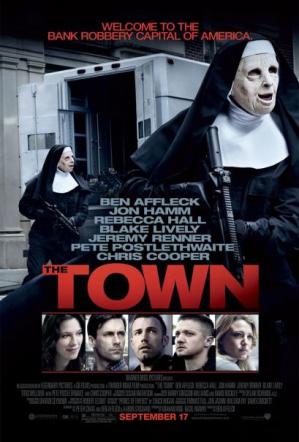

I missed out on The Town a couple years ago when it was a big mainstream success and all that.  It's not really the kind of movie I'd typically be interested in, but a combination of crazy good word of mouth and my excitement over seeing Argo finally caused me to cave.  And you know what?  I'm glad I did.  It's a solid and satisfying movie all around, even though we've seen much of it in other movies before.

Ben Affleck stars as Doug MacRay, the leader and mastermind of a ring of Boston bank robbers.  They take the manager, Claire (Rebecca Hall), hostage in the opening heist, and Doug lets her go without hurting her.  He knows that his unstable best buddy Jem (Jeremy Renner) will kill her if she can identify them, so Doug keeps tabs on her, and they strike up a relationship.  Now Doug must keep Claire safe, keep Jem in check, dodge Jon Hamm and the FBI, who are hot on his trail, and plan and execute his next heist under their noses, all while experiencing deep reservations over the life of crime he's chosen for himself.

Affleck really knows what he's doing, if you're wondering.  He had a good script in his hands (which he helped write), surrounded himself with a great supporting cast and crew, and directed the hell out of this thing.  The heists are smartly executed and exciting, the characters are all around interesting and engaging, with layers of conflict between them.  Jeremy Renner steals the show, but everyone is good.  Yes, I would say that Affleck has given his career a second leg that will have much more staying power than his Bruckheimer years.  And good for him. 

 --------------------------------------------------

Well, I kept them both mercifully short today.  I've just been so busy!

Monday, October 8, 2012

Teenage Wastelands: Wild in the Streets and G-a-s-s-s-s

Wild in the Streets, by Barry Shear, 1968


In the mid to late 60's, it was becoming clear: for the first time, the youth were calling the shots.  There were more teenagers than ever, thanks to the post World War II baby boom, and they were making sure their voices were getting heard, through protests and pop culture.  It was only a matter of time before this was addressed in a movie.

Barry Shear's Wild in the Streets is a darkly satirical take on the idea of teenagers taking power.  It stars Christopher Jones as Max Frost, a rebellious, but highly intelligent young man who runs away from his parents (but not before taking a few swipes at their prized possessions), and starts a new life of sex, drugs, and rock & roll.  He forms a band, who are also his entourage and think tank, and together, they begin fighting to lower the voting age to 14, by writing hit songs motivating an army of teenage fans to organize and revolt.  Once Max gets what he wants, though, it's not enough anymore, so he keeps pushing for more, and the world quickly turns into a dystopia.  It's basically a crazy dark version of this comic book.


Wild in the Streets pushes all of its ideas to their furthest extreme, and doesn't pull punches.  I think it's aged very well, too.  It's dark and extremely cynical, and it doesn't make any effort to make even the protagonist likeable.  There are no good guys in this movie, and that makes it even more fun.  The soundtrack is pretty good, too.  Usually fake bands in movies don't have good songs, but Max's band has some really good stuff, including one song that became a hit in the real world, "Shape of Things to Come".  Also, the editing in Wild in the Streets got a well deserved Oscar nomination.  It has a great ending, too.  The last line is laugh out loud funny.

G-a-s-s-s-s, by Roger Corman, 1971


G-a-s-s-s-s is kind of like Wild in the Streets if it was stupid.  I mean, it's actually kind of enjoyable, but it's not making any kind of big political statement or anything.  It's about what happens if a mysterious gas is released that kills off everybody over the age of 25.  While the smart teenagers in Wild in the Streets would have probably been ready to take over and pick society back up, Roger Corman's youths are probably more realistic: they spend most of the movie goofing around.

Corman was clearly less interested in making a statement than he was in making a movie that teenagers will shell out their cash for.  It doesn't stand the test of time nearly as well as "Wild", and it wasn't intended to.  It's loaded with pop culture references many of which flew right over my head.  This is a movie for the kids of 1971, not the kids of 2012 or any other time.  He obviously didn't foresee the home video market.  G-a-s-s-s-s has a soundtrack by Country Joe and the Fish, which is not bad, but it doesn't have the punch that the original songs in the other movie had.  It also, like many Roger Corman films, has a cast of several young actors on the rise, including Bud Cort, Cindy Williams, and Talia Shire.

One bit that I liked was that when the end of the world comes, the kids all sort of split into their high school cliques.  When everybody is looting, the jocks steal all the meat.  Later, we learn they're all dying of poor nutrition and want the vegetables that the hippie kids are growing.  I thought that was pretty clever.

I would never trash on Roger Corman.  I love the guy.  He directed and produced lots and lots of stinkers, a bunch of decent, fun movies, and once in a while, a real gem of a film would squeeze through.  G-a-s-s-s-s is not one of the gems, but it's one of those decent fun movies.  It's often doubled with Wild in the Streets, and I can see why, but Wild in the Streets is the superior film by a wide margin.

Thursday, September 20, 2012

Metropolitan, War of the Arrows, Withnail and I

Metropolitan, by Whit Stillman, 1990


Holy cats, guys, I think I've finally found my Whiteness Threshold.  I'm a dedicated Wes Anderson fan, I listen to and enjoy Vampire Weekend, and I say things like "holy cats", so I'm pretty white, but I think Whit Stillman's Metropolitan may have been too white for me.  It's a pretty good movie, I guess, but I just couldn't relate.

Metropolitan follows the lives of a group of rich New York college kids who are a part of the debutante society.  They meet up on weekends and talk about intellectual bullshit (and it's pretty bullshitty, they're college freshmen after all) and basically act like people I could never have a conversation with.  The main character is a kid named Tom, who has hit a financial rough patch with his parents' divorce, and is hanging out with these snobby types even though he's poor.  He's just as pretend smart as the rest of them, though; one of my favorite jokes was when he quotes a criticism on Jane Austen and the girl who likes him, Audrey, asks if he's ever even read the book.  He admits that he hasn't.  In fact, he doesn't read books at all, only criticism.  That way he can get the story and a point of view on it.

Anyway, I'm just giving the movie a hard time.  Objectively speaking, Metropolitan is a good film.  And the characters actually do grow on you as the story progresses, though I still constantly found myself thinking, "do people REALLY talk like this?"  Whit Stillman is kind of gently making fun of kids like this (with a name like Whit Stillman, I assume he was once one of them), and showing that for all their intellectual and cultured talk, they're really just teenagers and they have no real life experience or wisdom to back up their ideas.  I actually would like to see Stillman's film The Last Days of Disco.  Even though I'm sure everybody still talks like this, the subject matter interests me.

War of the Arrows, by Han-Min Kim, 2011

With The Hunger Games and The Avengers and Brave all out this year, bows and arrows sure are popular.  Well, South Korea got the jump on our little trend and made a huge historical epic last year with more arrows than you can shake a bow at.  This movie has more bows and more arrows than all three of those movies COMBINED.  Not only that, but people get shot with said arrows in every imaginable way.  In the arms, in the legs, in the chest, you name it.  Necks.

War of the Arrows isn't all just arrows.  There is also WAR.  And also a brother forming a ragtag group to rescue his kidnapped sister and ward off an invading army.  It's really cool.  The story is engaging, the action is awesome, the characters are likeable.  These are all icing on the cake, though, because what I'm most excited about is the arrows.  The only way this movie could have been better is if the main character had a talking arrow who helped him aim or something. 

Anyway, I know this review is really short and one-note, but I liked War of the Arrows a lot.  Totally worth your time.

Withnail and I, by Bruce Robinson, 1987

Withnail and I is one of the strangest films I've seen in a while, and followers of this blog might know that I watch a lot of strange films.  It's the story of two struggling actors in London in the late 1960's.  Withnail (Richard E. Grant) is a hard livin' type, pretty much a drunk, always raging at the world.  "I" (Paul McGann, AKA the 8th Doctor) is the sort of complacent second fiddle who always goes along with Withnail's schemes and worries himself to death all along the way as they get into deeper and deeper trouble.

There's not really much more of a "story".  It's just a ridiculous, darkly comedic, and weirdly enjoyable chain of events.  They go to get money from Withnail's rich, gay uncle, wind up stealing his car and the keys to his country house.  They end up stranded there with no money.  Then the gay uncle turns up and tries to seduce "I".  And so on.

Withnail and I kind of reminds me of the Coen Brothers' cult classic The Big Lebowski.  Both have lots of non sequiturs, a seemingly-but-not-really random story, and indefinable in terms of genre.  I was also pleasantly surprised to see Ralph Brown, the aging concert promoter guy (or whatever, I haven't seen it in many years) in Wayne's World 2.  He's basically playing the same guy in this, and he's just as hilarious.

I (me, not the character) thought Withnail and I (the character, not me) was really enjoyable, but maybe I didn't get it.  I'm sure it had some deeper meaning in there, there was definitely some commentary on the end of the 60's.  I might have to watch it a second time and see if there's anything I'm not picking up on.  Even if there isn't, it's a pretty great movie.

Thursday, September 6, 2012

Riki-Oh: The Story of Ricky and Breathless: There Are Lots of Different Ways to Be Great

Wow, everybody, I'm not going to make a big deal of it, but Riki-Oh: The Story of Ricky is the 300th movie I've reviewed on I Probably Liked It. That's a lot of movies for someone to probably like in only 20 months! I haven't slowed down at all since watching it either. I still have almost 30 movies to review. I'm really wanting to be caught up by the end of this month, but writing takes a lot of time that I don't necessarily have, so we'll see.

Riki-Oh: The Story of Ricky
, by Lam Nai-Choi, 1991


I've been hearing about this movie since I was in 9th grade. Back in the early, pre-Stewart days of The Daily Show, they always used to show a clip of a guy smashing another man's head with his fists like Ghallagher smashes a watermelon with a sledgehammer. The older geeks who were more in the know than I told me about The Story of Ricky, and thus a legend was born.

Riki-Oh: The Story of Ricky, set in a hellish not-too-distant future of 2001, is about a good guy who is imprisoned for killing a crime boss. The prison is just as corrupt as the outside world, as Ricky soon learns when he comes to the defense of a poor old man who is just shy of parole. In doing this, he makes enemies of not only the worst of the prisoners, but also the evil warden and his lackies. Now Ricky must fight his way through these guys and out of the jail that would rather see him dead.

This movie is nuts! I don't know why it took me so long to see it. I guess because it was never sitting directly in front of me, until it popped up on Netflix. The violence is super over-the-top and hilariously fake looking. It's like if Evil Dead 2-era Sam Raimi made a science fiction kung fu prison drama/comedy. We're in a world where pretty much anything can happen. We see Ricky smash his fists through heads and torsos, and one of his foes tries to choke Ricky with his intestines at one point. Ricky has superpowers and is basically indestructible, unfortunately for these bad guys. You never feel like the odds are overwhelming for the hero, you just watch to see how he's going to eviscerate one boss after another.

I'm guessing my description isn't really selling Riki-Oh. You're probably wondering what's so appealing about it. It's hard to do this movie justice with words. Let me just say that it's weird and funny and culty and great to watch with a group of friends (inebriation optional). Riki-Oh: The Story of Ricky is off its rocker, and totally awesome for it.

Breathless, by Jean-Luc Godard, 1960


While I think you could say the Story of Ricky achieves a kind of greatness, Jean-Luc Godard's Breathless is the real deal. Sure, it doesn't have a scene where the hero shoves a bad guy into a meat grinder, but it has its own non-meat-grinder related merits. There's a reason this film is frequently voted by critics as one of the best ever made.

One of the films that kick started the French New Wave, Breathless is the story of Michel (Jean-Paul Belmondo), a guy who steals a car and shoots a cop and now needs money to get out of the way. He goes into the city to find someone to give him a loan. While he's there, he also tracks down Patricia (Jean Seberg), an American girl he's slept with a few times, and wants to come with him. Much of the movie is set in her apartment, as they smoke cigarettes like they're in a French movie and discuss their situation and she tries to determine whether she loves him or not, while the cops are out there tracking him down.

It says something about a movie when it is the source of all the stereotypes of what a certain kind of movie is. Breathless is like that. Every American parody of an "artsy" French film on TV, in cartoons, and in movies, is just doing its own version of Breathless. This is that movie. The philosophical voice-over narration of the hero, the frequent use of jump-cuts. Not only often parodied, but often used for serious. The way Godard used jump-cuts in his editing was a brand new thing at the time, though it's become recognizable and commonplace over the last 50 years.

I had seen Godard's Alphaville before this, and I liked it, but now that I've seen Breathless, Godard seems much easier to get into. It's bold, groundbreaking, and personal and it still feels that way half a century later. This would have been a much better film for me to start off with.

Monday, August 27, 2012

Mommie Dearest and The Swimmer: Two Bizarre Films by Frank Perry

Mommie Dearest, by Frank Perry, 1981
Mommie Dearest probably needs no introduction. It's a true camp classic, with one of the greatest over-the-top performances in movie history: Faye Dunaway as unhinged screen legend Joan Crawford is a sight to behold. It's the "true"? story of Christina Crawford, Joan's adopted daughter, who suffered a lifetime of verbal and psychological abuse by her crazy movie star mother. I'm sure there is actually a good deal of truth to the story, but the movie and its star are just so excessive that I can't imagine it played out like this in real life.

Even if you haven't seen Mommie Dearest before, scenes and lines have become part of pop culture. I'm sure we all know the "No More Wire Hangers" line, right? I feel kind of bad for Faye Dunaway, for being so ashamed of this role. It's a tour de force, whether she acknowledges it or not. She really transforms herself into Joan Crawford, and when Crawford goes crazy, Dunaway is hilariously and delightfully watchable. I know that's probably not what she intended to be, but we've seen Network, Chinatown, and Bonnie and Clyde, so we know Faye Dunaway can act. And act she does. And act and act and act. Nobody told her she was acting in a comedy.

Mommie Dearest is a rare instance of a studio putting a new spin on their marketing of a movie. When audiences at screenings laughed throughout, Paramount decided to sell it as high camp, and made a tidy profit on it. We all know that Dunaway wasn't happy. I wonder what director Frank Perry thought of it. I kind of get the sense that that was what he was going for all along, but who knows? There's a scene toward the end when 20-something Christina falls ill and her 60-year-old mother fills in for her on the soap opera she was acting on while she recovers. That's hilarious! And I felt like Frank Perry was aware of the humor of it all.

Regardless of whether it was meant to be funny or not, Mommie Dearest is one of the most insane movies ever made. Utterly tasteless, but undeniably watchable. Its cult status is well earned.

The Swimmer, by Frank Perry, 1968
After seeing Mommie Dearest, I was curious about the work of Frank Perry, so I sought out his 1968 film, The Swimmer, adapted from a John Cheever short story. It's a surreal, allegorical tale about Ned (Burt Lancaster), a successful man who decides to swim home through all the swimming pools across the county. On his journey through his neighbors' backyards, Ned encounters many people from his past, and has discussions with them, where more and more about his own nature is revealed, before swimming through their pools and running to the next yard. As the movie progresses, we realize, along with Ned, that he isn't the happy, successful, pleasant man he at first seemed to be.

The Swimmer is very much a piece of late sixties weirdness. It hasn't endured or held up the same way a lot of the major movies from that time period have. It kind of shares some themes with The Graduate. Not only the whole swimming pool thing, but also the notion that our ideas of success and The American Dream have become rather hollow, an idea very much prevalent in the 1960's.

I found The Swimmer to be an interesting film, but not a great one. This may come as a surprise, but this movie by the director of Mommie Dearest is NOT the most subtle of allegories. Everything is really on-the-nose, and you feel like he is driving the point home by repeatedly punching your face with it. As the narrative progresses, Ned, having been swimming, running half naked through the woods, and realizing what a piece of shit he is all day, starts getting colder and colder. By the end of it, he's basically holding out his fists and yelling "NOOOOOOOOOOO!", like Darth Vader at the end of Revenge of the Sith.

Still, The Swimmer is at least an interesting artifact of its time, and worth noting for that. They don't make movies like it now, and there was really only a brief period where they did.

Faster, Pussycat! Kill! Kill!, and The Naked City

Faster, Pussycat! Kill! Kill!, by Russ Meyer, 1965

In the heyday of exploitation movies, one of the most important factors in getting butts in movie theater seats was to have a tantalizing title. I doubt there's ever been a title that piques curiosity more than Faster, Pussycat! Kill! Kill! Russ Meyer struck gold with that one, I must say. The real challenge is making a movie that lives up to that title.

Well, Faster, Pussycat! Kill! Kill! is a true classic, at least as far as trashy movies go. Look, it's not Gone with the Wind, but it does have a certain quality. It's the story of three badass go-go dancers, Billie, Rosie, and their leader, Varla (Tura Satana). While road racing in the desert, they come across a couple of goofy teenagers. Varla kills the boy and they end up kidnapping the girl. They then find themselves scheming to rob an old man in a wheelchair and his two sons (including a dumb, muscular one named The Vegetable), while their teenage hostage tries to get away.

That's basically the story. It almost felt like Meyer and his cowriter Jack Moran were just going "and then this happens", "and then this happens", when they were writing the screenplay, because I don't know how else you would make the leap from "road-racing go-go dancers kill a teen" to "then they end up on a ranch". Not that I'm complaining, though. The movie is weird and plenty of fun. I was amused by how un-trashy this trashy movie seemed. There's not even nudity or anything in it, the violence is tame, it's just, you know, titillation. There's almost an innocence to it. A few years later, this movie would have been wayyyy more exploitative.

Faster, Pussycat! Kill! Kill! is a fun and memorable B-movie, but I'm not sure if it would have endured the way it has if it didn't have that crazy title. I'm glad that weird stuff like this exists, though.

The Naked City, by Jules Dassin, 1948

If you traced the police procedural drama genre all the way back to its roots, Jules Dassin's 1948 Film Noir, The Naked City, might have been the starting point. I could be wrong, but I'm guessing it was at least the beginning of the modern era. The Naked City plays like the original Law & Order episode.

It begins with the murder of a model. Two police detectives, Muldoon and Halloran (Barry Fitzgerald and Don Taylor) begin their investigation. We then see the entire investigative process play out, interviewing witnesses, looking for clues, and following leads, until ultimately, they find their man. I know I'm being vague, but look, it's a really successful formula that we all know by heart by now, don't we?

I don't mean to say that The Naked City is formulaic. I don't believe it was at the time. I think it might be a big reason the formula is so prevalent today. It's a great movie, it even won a couple Oscars. The mystery is very well constructed and richly layered. The cinematography, on location in New York City, is fantastic. The characters, including the investigators, suspects, witnesses, and even the murderer are all given depth and dimension. There's a great scene where Halloran goes home to his wife, who begs him to discipline their son, which he doesn't believe in. We learn a lot about his nature in that one scene. He's not going to hit his kid, which says a lot about a man in 1948.

The Naked City is a classic, and a very influential film. Jules Dassin made some pretty groundbreaking movies. In addition to revolutionizing the police procedural with this, he practically invented the heist genre too, with 1955's Rififi (more on that whenever I actually see it). The only other film I've seen by him is Topkapi, which is another fun and influential heist movie.

Thursday, June 21, 2012

Tim & Eric's Billion Dollar Movie

A good test you can give yourself to determine whether or not you would like Tim & Eric's Billion Dollar Movie is:

1: Have you seen Tim & Eric before on TV or the internet?

2: Did you like what you saw?

If you answered yes to both of those questions, you just might enjoy their movie. These guys are the definition of the words "Not for Everyone". Over the years, Tim Heidecker and Eric Wareheim have made a career of their shorts, that often use amateur techniques that are indistinguishable from a 1980's VHS infomercial that you might find in a bin at a Salvation Army. Their comedy is surreal, obnoxious, subversive, and often will take a turn for the nightmarish. Their unique voice has also earned them the respect of pretty much everyone else who matters in the comedy world, if not the world at large.

Now Tim & Eric have taken their first step into the movie world, and it's every bit as strange and culty as you would expect. Tim & Eric's Billion Dollar Movie, is the story of Tim & Eric, playing themselves, who somehow got a billion dollars from Hollywood studios to make a movie. The movie that resulted, "Diamond Joe", starring a Johnny Depp impersonator in a suit made of diamonds, cost so much money that they were only able to shoot three minutes of it. They are held responsible by the studio heads, and must find a way to pay back the billion dollars. As luck would have it, they see a commercial where a man offers a billion dollars to anyone who can fix up his shopping mall.

Tim & Eric then form a PR firm called "DOBIS" (the origins of that name was one of my favorite bits), and set out to bring business back to a dilapidated shopping mall with used toilet paper stores and a sword shop whose owner doesn't actually want any business. The plot really makes little sense. It's just there to loosely tie together a bunch of weird characters and bizarre jokes.

So does it work? As someone who enjoys Tim & Eric, though I haven't watched a lot of them, I think a lot of it does. It's not perfect, but a lot of the jokes got me. For example, I really liked when they first meet the owner of the mall (Will Ferrell) and before they talk, they watch Top Gun together. When it's over, they watch it again. I also liked the showdown with the movie studio heads at the end. As I said, I laughed a bunch, though I didn't care for the scatological stuff, as bizarre as some of it was.

Tim & Eric are two comedians who really don't seem to care if they're making everybody laugh, or just themselves. I respect that attitude a lot. It's how they got their cult status in the first place. In their movie, they surround themselves with bigger stars (and frequent collaborators) who are similarly fearless and unconcerned with reaching everybody or just the few people like them. Supporting roles are filled by kindred spirits such as Will Ferrell, John C. Reilly, Zach Galifianakis, and Will Forte, all fully willing to give themselves over to Tim & Eric's weird vision.

I think you should only watch this if you're a T&E fan already. They have 5 seasons worth of insane, surreal sketches, most of them posted on Youtube. You should check some out if you haven't, these guys actually work better in short bursts than they do at feature length. If you've watched their Adult Swim show and approve, you might find some enjoyment in the Billion Dollar Movie, though I can't imagine someone unaware of these guys making it through 90 minutes of their antics.

Monday, April 23, 2012

Fire and Ice

In my adolescent years, movies like those of the animator Ralph Bakshi were pretty hard to come by. My only opportunity to get my hands on many of those underground cult films was at a comic book convention, every six months or so. I still have a bootleg VHS of Bakshi's bizarro 1977 animated fantasy, Wizards, buried away somewhere, and his animated Lord of the Rings movie as well.

Nowadays, of course, the movie studios realize that there is indeed a market for the strange, and have released Bakshi's work and many of the other Comicon oddities from my youth on DVD and Blu Ray, or are streaming them digitally. So now, here I am at 30, getting to watch his 1983 animated feature, Fire and Ice, instantly on my TV.

Fire and Ice has quite a geek friendly pedigree. In addition to being directed by Bakshi, it was developed and designed by legendary fantasy illustrator Frank Frazetta (see poster above), and the screenplay was written by two of the all time great comic book writers, Gerry Conway and Roy Thomas. Conway is perhaps best known for writing the Death of Gwen Stacy story in Amazing Spider-Man, considered the most important Spider-Man story pretty much ever. Thomas wrote Marvel's Conan the Barbarian comic books in the 1970's, making him a perfect choice for this movie.

Fire and Ice is the story of two warring kingdoms. The evil Nekron attempts to kidnap the might-as-well-be-naked Princess Teegra to make her his wife. She escapes and is assisted on her journey home by a musclebound villager named Larn. When she is kidnapped again, it is up to Larn and the super-badass masked man, Darkwolf to rescue her and defeat Nekron and his evil queen mother.

Bakshi used rotoscoping in his animation, drawing over live action elements, which saved much time and money for his relatively low budget operation. This gives the movements and characters a nice, realistic weight and believable human movements. Of course, not everything is rotoscoped. I can't imagine the pterodactyls were, for example. By the way, people storming a castle on the backs of pterodactyls is pretty awesome.

Fire and Ice was made in 1983, right before Gremlins and Indiana Jones and the Temple of Doom forced the hand of the MPAA into creating the PG-13 rating, so don't let that PG fool you into showing it to the kids. It also gets a lot of leeway for being animated. This movie would be an R if it came out today. As I said before, Teegra is pretty much naked the entire time, very little is left to the imagination. Also, it's quite violent. People take axes to the head, spears to the chest. All that stuff. It's not even hidden in shadow or conveniently off-camera, tricks used by many PG-13 movies nowadays.

As a whole, the movie itself is enjoyable, but not great. The animation is really cool, though, and it has a genuinely comic-book-y feel to it. The voice acting is not exactly top notch, and it doesn't exactly have the most complex of stories, but Fire and Ice hits the right mark when it comes to appealing to the 12-year-old-boy part of the brain.

Tuesday, April 17, 2012

American Grindhouse

Any regular readers of this here webbity page can probably tell that I love watching B movies, cult movies, and other such cinematic oddities. I love the strange and fantastical, and many of my favorite movies are the ones that show me things that I have never seen or even imagined before. As an extension of that, I also love watching documentaries about such films. After watching them, I always end up with huge lists of movies I want to check out.

Elijah Drenner's documentary American Grindhouse is basically a complete history of exploitation movies, going back all the way to the dawn of cinema. It's highly informative, demonstrating through footage and interviews with experts, fans, and participants in the genre, how the societal mindset of each era was reflected in the usually cheap, often seedy films that played in the dingier, more rundown theaters across America.

I learned a lot, and perhaps saw some things that I can't unsee, such as a live birth (surprisingly, I handled it well), and footage from Tod Browning's Freaks, which I always kind of avoided, because that kind of stuff always makes me sad (it still made me sad).

I loved the section of the film about the films of the 1950's. I thought it was hilarious that there was an entire genre of Nudist Camp movies, just showing naked people frolicking and playing volleyball and stuff. That's such a strange, sexless way to sell sex that it could only have come from the repressed 1950's, you know?

The sixties are when things started to get pretty sick, which also makes sense because society was getting pretty sick, too. You know, turbulent times, and stuff. That's when the nudie movies got violent, and the horror movies got gory. I liked learning about Herschell Gordon Lewis, AKA the Godfather of Gore, who most of you might know from the scene about him in Juno. I'm not sure if I want to see his movies, but the guy was a trailblazer, taking horror movies to the over the top, Grand Guignol level.

A great debt is also owed to Roger Corman, who I have a particular appreciation for. He directed and produced so many independent movies, and found so many major movie talents in the process, that you could make an entire movie just on him. (What? They already have? I plan on watching that one too!) He was always able to tap into what the youth were looking for and, well, exploit it.

Eventually, in no small part due to Corman and the generation of talent he discovered and mentored (Scorsese, Nicholson, Dante, Demme, the list goes on...), exploitation movies became the mainstream blockbusters that we go and see today. Which is exactly why knowing this history should be important to anyone who loves the movies.

I seriously love documentaries like this. I always end up with huge lists of movies I want to see after I watch them. Did I mention it was narrated by Robert Forster? Pretty cool, right? Just be warned if you watch it: lots of nudity, lots of gore. Put the kids to bed!

Anyway, if you watch American Grindhouse and are still interested in learning about movies like this, might I direct your attention to the fantastic documentaries of Mark Hartley? Instead of the broad picture that American Grindhouse paints, Hartley narrows his focus to specific global movements or subgenres and digs deep. Not Quite Hollywood covers the Australian "Ozsploitation" movement, and Machete Maidens Unleashed covers Corman's exploits making movies on the cheap in the Phillipines in the 70's. Fascinating, educational and funny stuff. All three of these movies are on Netflix Instant (if you're in America, at least).

Dirty Mary, Crazy Larry

I've known about Dirty Mary, Crazy Larry for a long time, read about it in books about cult movies, surely I've heard Quentin Tarantino mention it at some point. After all these years, I still can't get the title straight in my head. Is it Dirty Mary, Crazy Larry, or is it Dirty Larry, Crazy Mary? Even watching the movie, I couldn't remember which was which. Because, you see, Mary didn't seem so dirty to me, but she did seem kind of crazy. And Larry was definitely crazy, but he was also kind of a dirtbag. Still, despite all my confusion, that title leaps out at you when you see it written out in front of you.

Right out the gates, Dirty Mary/Larry, Crazy Larry/Mary puts all the pieces in place for a perfect car chase movie. Larry (Peter Fonda) is a race car driver. His friend Deke (Adam Roarke) is a mechanic. Together they hatch a plan to rob a ton of money from a guy. They hold the owner's family hostage at home, while getting him to hand over the money in the store. Roddy McDowall is the store owner, and it's a tiny role, but I still ended up really liking his character, because it's made clear that he's no dummy.

The plan goes off, almost without a hitch, until Larry gets in the getaway car, only to find Mary (Susan George), his one-night-stand from the previous night sitting in there waiting for him. He tries to get rid of her, by being a jerk, but she wants to come along for the ride and she won't take no for an answer.

Meanwhile, the sheriff (Vic Morrow) has already begun a search for them, sparing no resources, and a high speed race to the border ensues, where Larry, Mary, and Deke use all of their wits and know-how to keep one step ahead.

The movie is well known for its car chases, and the car chases are absolutely great. 1970's car chase movies are so much better than modern car chase movies because they really did the stunts you see up on the screen. There's no CGI at play. No quick cutting. Just real stunts with real cars.

But the action isn't the only draw. The interaction between the characters is just as good. Peter Fonda's Larry is a mean guy, but that doesn't mean you don't like him. He walks that line really well. Susan George is really likeable as Mary, who, though unwanted at first, earns the respect of Larry and Deke, and is eventually accepted as part of the team. I actually liked her the best of the three.

The classic French film The Wages of Fear casts a heavy shadow over a lot of these 1970's movies involving vehicles. Dirty Mary, Crazy Larry is actually the second 70's film that I've seen in the last few months with an ending that owes everything to Wages of Fear. The other, of course, is The Italian Job. And these were both made before William Friedkin flat out remade Wages of Fear with his movie Sorceror (which I have yet to watch). I wonder if there were many movie-goers back in the day wondering why all these movies coming out had such similar endings.

Dirty Mary, Crazy Larry is cool, culty, gritty, and action packed, with an intelligent script and memorable characters. I've never seen anything else by director John Hough, though it looks like he made some pretty memorable movies in the 70's. He did a great job with this one. It's one of the most memorable and exciting car chase movies of all time.

Tuesday, March 27, 2012

Escape from New York

It's no secret that John Carpenter made a lot of really fun movies in the first ten to fifteen years of his career. Most of them are now considered cult classics and 1980's mainstays. Watching one of his movies brings me back to the days of looking at the walls of VHS tapes at the video rental on a Friday night, trying to decide what to watch with my friends.

Escape from New York is one of those culty '80's movies that somehow eluded me in my rental-frequenting adolescence. The story is gloriously ridiculous and pretty minimal: It is the future. The year 1997. New York City has been converted into a giant walled island prison. On its way to a summit, Air Force One is hijacked and crashed into the city. The president (Donald Pleasance) survives, only to be caught and held hostage by the inmates. The guards, at a stalemate, have no choice but to recruit a former prisoner, Snake Plisskin (Kurt Russell in one of his most iconic performances), to rescue him.

The movie is goofy and tongue-in-cheek, yet still sincere, in that way that Carpenter's more action oriented fare is. I love the hilariously dated vision of the future we're given, with Atari-quality computer graphics and whatnot. Plissken must go through a lot to save the president, who is basically dead weight. The prison warden (Spaghetti Western legend Lee Van Cleef) straps a bomb to him and gives him a 24 hour deadline. He teams up with a cheerful cab driver (Ernest Borgnine), and an imprisoned scientist and his girlfriend (Harry Dean Stanton and Adrienne Barbeau). He faces various New York gangs, all sorts of crazies, and The Boss (Isaac Hayes), the prison kingpin.

Kurt Russell's Snake Plissken is, well, it's Kurt Russell's Clint Eastwood. He walks into town like The Man with No Name, cleans out the riff raff (well, to an extent. It's a prison.), and gets out of dodge. He has very little dialogue throughout, he just conveys his character through squinty stares and sneers. I love that Carpenter had Russell do Eastwood in this and John Wayne in Big Trouble in Little China.

Harry Dean Stanton is pretty great as The Brain, too. I bet he didn't get too many chances to play scientists throughout his career.

Escape from New York provides a whole lot of fun, and delivers as an over the top action movie and as a piece of cheesy 80's kitsch. I love that Carpenter had Russell do Clint Eastwood in this and John Wayne in Big Trouble in Little China. Big Trouble is still my favorite of Carpenter's films, but the two movies make great companions.

Wednesday, February 29, 2012

Flash Gordon

Ahh, the space opera. This is a genre I have a deep love for, even the kinda shitty entries. A good space opera takes us to all sorts of weird and wondrous places, pits the best of the good versus the worst of the evil. They have larger than life characters (and actors), and little to no attention is paid to the laws of physics.

I don't know how I'd never seen Flash Gordon before. Based on the classic comic strip and serial shorts, Mike Hodges' Flash Gordon movie was one of many similar (but inferior) space operas made in the wake of Star Wars. The title character, played by Sam J. Jones, is a football star, who along with a plucky journalist and a mad scientist, are transported to the world of the malicious space dictator, Ming the Merciless, and must lead a rebellion and save the earth from his tyranny. It's campy and silly from the very premise, but entirely watchable, made so by some pretty decent filmmaking, and a cast of actors playing their characters with earnest conviction.

I especially liked Timothy Dalton as Prince Barin, a rival who Flash must form an unsteady alliance with to defeat Ming, who is played by Max von Sydow. You've also got the boistrous Brian Blessed, as Prince Vultan, a Hawk Man who has never heard of the concept of indoor voices.

Sam J. Jones doesn't speak very much in the lead role, but he looks the part. I assume they casted him for his looks and not his ability to get inside a character. Or perhaps there's not a good deal of character to get inside. It's ok, though, because the rest of the cast elevates him. There's a ridiculous but enjoyable sequence early on where he takes down a bunch of Ming's evil guards by using his football skills.

The most famous and enduring part of the Flash Gordon movie is, of course, the score, composed by the legendary rock band, Queen. In fact, I owned the soundtrack long before I ever saw the movie. The theme song is a Queen classic (FLASH! AHHHAHH...SAVIOR OF THE UNIVERSE!). I wish there were actually more pop songs mixed in with the synthesized score, they would have fit into the movie just fine, and nobody wrote pop songs like Queen.

Flash Gordon is a pretty fun movie, if you don't mind the goofiness. Which I don't. I liked the universe it was set in, which was imaginative and rich, and weird. The cheese just adds to the overall craziness of the thing. It's kind of like male Barbarella with significantly less sex stuff. On a Space Opera scale with Star Wars Prequels as the low and the original Star Wars flicks as the high, Flash Gordon would be nestled comfortably somewhere in the middle.

Tuesday, December 13, 2011

Assault on Precinct 13 (1976)

What does it say about me that as a lover of cinema, I still have never seen a film by Godard, Fellini, or Bergman? Or that I haven't seen Gone with the Wind or The Ten Commandments? I've never seen a film by William Wyler and the only John Ford film I have seen is Stagecoach. All of these statements are sad but true. But what is even sadder is that, given the choice between watching one of these movies or watching an early, lesser film by John Carpenter, my goddamn geek instinct will always make me choose Carpenter.

Lesser isn't quite the word. In the 90's, Carpenter's work got far lesser than his second film, 1976's Assault on Precinct 13, could ever be considered. But when you compare Assault on Precinct 13 to the Carpenter craziness that was to come in the next decade; Halloween, The Thing, Big Trouble In Little China (my favorite), or even the cornball fun of They Live!, it's surely the work of a director who was just starting to hit his stride.

Assault on Precinct 13 is set in Anderson, a slum of Los Angeles, where a street gang runs rampant, armed with a supply of automatic weapons. When a guy kills one of their members in retaliation for his little girl's murder, they chase him to the local police station, in the process of shutting down. The few remaining officers there must then team up with the convicts and defend their fortress from a seemingly endless onslaught of LA gangbangers.

The movie is a lot of fun once it gets started. Sort of a modern western mixed with a zombie movie, but the zombies aren't dead. The problem is, it takes a really long time to get started, 45 minutes before all the chess pieces are in place. Come on now, John Carpenter, you've got to make your way through act 1 as fast as you can.

The acting isn't exactly top notch for the most part, but the two leads are pretty enjoyable, especially Austin Stoker as Ethan Bishop, the heroic cop. Surely taking inspiration from Night of the Living Dead, Carpenter makes his hero a black man without ever drawing attention to that fact, something that is rare even now, but was practically unheard of in 1976. Darwin Joston plays the roguish Napoleon Wilson, the badass crook with a heart of gold. He spends much of the movie asking for a smoke and not telling people why he's called Napoleon.

The gang is portrayed as a faceless force of evil rather than individual people, almost supernatural. They just keep on coming, pressing down on the Precinct, and seemingly never running out of ammo and men. They've cut the power and phone lines, and after every attack, they clean up all the bodies and hide, so nobody will notice their presence. I doubt that would really work, but you buy it in the movie.

I enjoyed Assault on Precinct 13 for what it was. It would play well with The Warriors, another similar (and superior) cult movie from the same time period that I only saw recently. Maybe next up I will finally watch a film by Godard, Fellini, or Bergman. On second thought, I have the rest of my life to watch those. I'll probably just watch Buckaroo Banzai again.