Looper, by Rian Johnson, 2012
Most Hollywood science fiction movies kind of come and go. I mean, look back at the 90's, they came out all the time, but only a handful of them are even remembered, and even fewer fondly. The ones that stick around are the smart, thoughtful ones with vividly imagined worlds and thought-provoking ideas. Not far into Rian Johnson's latest film, Looper, I realized that this is
going to be one of those movies that science fiction fans are still
watching and talking about 30 years from now.
Joseph Gordon-Levitt stars as Joe, a man employed by organized crime to kill people sent back from the future. They pay him well, with the understanding that sooner or later, he will have to "close the loop", by killing his future self. Things go awry when his future self (Bruce Willis) gets the drop on him and escapes. Now Joe must---
Jim! We have to hurry!
What? Who are you?
Don't you recognize me? I'm the you of 2042.
Oh my god, it is you, me. Why are you here?
I came back to warn you that 30 years from now, nobody is watching or talking about Looper.
Oh no! How can this be?
It's our fault. It's our review, Jim! It was so poorly written that President Honey Boo Boo had the movie outlawed. Real Steel is being played 24 hours a day on 3-D supertelevisions around the globe.
NOOOOOOOO!! I have to stop this horrible future from happening. But HOW?
There's only one thing we can do...
What...? What are you doing with that gun, future me? No.. NO!
I'm sorry, young me, it's for the good of the future...
*BLAM!*
He... he shot me... then disappeared... that must... mean... I'm not going to... make it. Only... time... for one last act. Must click... Publish... tell the people... about... LOOPER... never forget... Tell my wife I...
Showing posts with label science fiction. Show all posts
Tuesday, October 16, 2012
Monday, October 15, 2012
The Brother from Another Planet, The Town
Hey, everyone! I'm almost to my October movies. I just have a couple short reviews here, (and I mean short) and a couple of reviews catching up on new releases, and then it's pretty much just horror for the remainder of the month, and probably spilling well into November, too. I love this time of year!
The Brother from Another Planet, by John Sayles, 1984
This is an interesting movie. The Brother from Another Planet is the story of an escaped alien slave who flees to earth and finds his way to Harlem, while the men in black (who are white aliens posing as immigration officers) try to track him down.
The alien is played by Joe Morton, best known (by me, anyway) as Dyson in Terminator 2. He has difficulty speaking in human language, so he remains mute for the whole movie, but Morton still conveys a lot in his silent performance. He's gentle, and curious about humans, and all their flaws. A lot of people take a shine to him even though he doesn't talk. He has a knack for fixing electronics like TVs and arcade games. He has few alien features, just weird three-toed chicken feet and a removable eyeball that he can use as a camera.
Anyway, The Brother from Another Planet is pretty good. It's got a low budget, but there aren't a lot of effects, so it's not distractingly cheap. It's a neat little science fiction allegory for the state of race relations in the 1980's, and it has a heart and a social conscience.
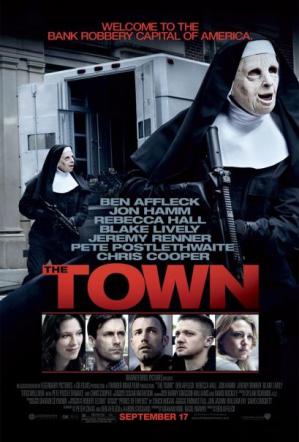
The Town, by Ben Affleck, 2010
I missed out on The Town a couple years ago when it was a big mainstream success and all that. It's not really the kind of movie I'd typically be interested in, but a combination of crazy good word of mouth and my excitement over seeing Argo finally caused me to cave. And you know what? I'm glad I did. It's a solid and satisfying movie all around, even though we've seen much of it in other movies before.
Ben Affleck stars as Doug MacRay, the leader and mastermind of a ring of Boston bank robbers. They take the manager, Claire (Rebecca Hall), hostage in the opening heist, and Doug lets her go without hurting her. He knows that his unstable best buddy Jem (Jeremy Renner) will kill her if she can identify them, so Doug keeps tabs on her, and they strike up a relationship. Now Doug must keep Claire safe, keep Jem in check, dodge Jon Hamm and the FBI, who are hot on his trail, and plan and execute his next heist under their noses, all while experiencing deep reservations over the life of crime he's chosen for himself.
Affleck really knows what he's doing, if you're wondering. He had a good script in his hands (which he helped write), surrounded himself with a great supporting cast and crew, and directed the hell out of this thing. The heists are smartly executed and exciting, the characters are all around interesting and engaging, with layers of conflict between them. Jeremy Renner steals the show, but everyone is good. Yes, I would say that Affleck has given his career a second leg that will have much more staying power than his Bruckheimer years. And good for him.
The Brother from Another Planet, by John Sayles, 1984
This is an interesting movie. The Brother from Another Planet is the story of an escaped alien slave who flees to earth and finds his way to Harlem, while the men in black (who are white aliens posing as immigration officers) try to track him down.
The alien is played by Joe Morton, best known (by me, anyway) as Dyson in Terminator 2. He has difficulty speaking in human language, so he remains mute for the whole movie, but Morton still conveys a lot in his silent performance. He's gentle, and curious about humans, and all their flaws. A lot of people take a shine to him even though he doesn't talk. He has a knack for fixing electronics like TVs and arcade games. He has few alien features, just weird three-toed chicken feet and a removable eyeball that he can use as a camera.
Anyway, The Brother from Another Planet is pretty good. It's got a low budget, but there aren't a lot of effects, so it's not distractingly cheap. It's a neat little science fiction allegory for the state of race relations in the 1980's, and it has a heart and a social conscience.
The Town, by Ben Affleck, 2010
I missed out on The Town a couple years ago when it was a big mainstream success and all that. It's not really the kind of movie I'd typically be interested in, but a combination of crazy good word of mouth and my excitement over seeing Argo finally caused me to cave. And you know what? I'm glad I did. It's a solid and satisfying movie all around, even though we've seen much of it in other movies before.
Ben Affleck stars as Doug MacRay, the leader and mastermind of a ring of Boston bank robbers. They take the manager, Claire (Rebecca Hall), hostage in the opening heist, and Doug lets her go without hurting her. He knows that his unstable best buddy Jem (Jeremy Renner) will kill her if she can identify them, so Doug keeps tabs on her, and they strike up a relationship. Now Doug must keep Claire safe, keep Jem in check, dodge Jon Hamm and the FBI, who are hot on his trail, and plan and execute his next heist under their noses, all while experiencing deep reservations over the life of crime he's chosen for himself.
Affleck really knows what he's doing, if you're wondering. He had a good script in his hands (which he helped write), surrounded himself with a great supporting cast and crew, and directed the hell out of this thing. The heists are smartly executed and exciting, the characters are all around interesting and engaging, with layers of conflict between them. Jeremy Renner steals the show, but everyone is good. Yes, I would say that Affleck has given his career a second leg that will have much more staying power than his Bruckheimer years. And good for him.
--------------------------------------------------
Well, I kept them both mercifully short today. I've just been so busy!
Monday, October 8, 2012
Teenage Wastelands: Wild in the Streets and G-a-s-s-s-s
Wild in the Streets, by Barry Shear, 1968
In the mid to late 60's, it was becoming clear: for the first time, the youth were calling the shots. There were more teenagers than ever, thanks to the post World War II baby boom, and they were making sure their voices were getting heard, through protests and pop culture. It was only a matter of time before this was addressed in a movie.
Barry Shear's Wild in the Streets is a darkly satirical take on the idea of teenagers taking power. It stars Christopher Jones as Max Frost, a rebellious, but highly intelligent young man who runs away from his parents (but not before taking a few swipes at their prized possessions), and starts a new life of sex, drugs, and rock & roll. He forms a band, who are also his entourage and think tank, and together, they begin fighting to lower the voting age to 14, by writing hit songs motivating an army of teenage fans to organize and revolt. Once Max gets what he wants, though, it's not enough anymore, so he keeps pushing for more, and the world quickly turns into a dystopia. It's basically a crazy dark version of this comic book.
Wild in the Streets pushes all of its ideas to their furthest extreme, and doesn't pull punches. I think it's aged very well, too. It's dark and extremely cynical, and it doesn't make any effort to make even the protagonist likeable. There are no good guys in this movie, and that makes it even more fun. The soundtrack is pretty good, too. Usually fake bands in movies don't have good songs, but Max's band has some really good stuff, including one song that became a hit in the real world, "Shape of Things to Come". Also, the editing in Wild in the Streets got a well deserved Oscar nomination. It has a great ending, too. The last line is laugh out loud funny.
G-a-s-s-s-s, by Roger Corman, 1971
G-a-s-s-s-s is kind of like Wild in the Streets if it was stupid. I mean, it's actually kind of enjoyable, but it's not making any kind of big political statement or anything. It's about what happens if a mysterious gas is released that kills off everybody over the age of 25. While the smart teenagers in Wild in the Streets would have probably been ready to take over and pick society back up, Roger Corman's youths are probably more realistic: they spend most of the movie goofing around.
Corman was clearly less interested in making a statement than he was in making a movie that teenagers will shell out their cash for. It doesn't stand the test of time nearly as well as "Wild", and it wasn't intended to. It's loaded with pop culture references many of which flew right over my head. This is a movie for the kids of 1971, not the kids of 2012 or any other time. He obviously didn't foresee the home video market. G-a-s-s-s-s has a soundtrack by Country Joe and the Fish, which is not bad, but it doesn't have the punch that the original songs in the other movie had. It also, like many Roger Corman films, has a cast of several young actors on the rise, including Bud Cort, Cindy Williams, and Talia Shire.
One bit that I liked was that when the end of the world comes, the kids all sort of split into their high school cliques. When everybody is looting, the jocks steal all the meat. Later, we learn they're all dying of poor nutrition and want the vegetables that the hippie kids are growing. I thought that was pretty clever.
I would never trash on Roger Corman. I love the guy. He directed and produced lots and lots of stinkers, a bunch of decent, fun movies, and once in a while, a real gem of a film would squeeze through. G-a-s-s-s-s is not one of the gems, but it's one of those decent fun movies. It's often doubled with Wild in the Streets, and I can see why, but Wild in the Streets is the superior film by a wide margin.
In the mid to late 60's, it was becoming clear: for the first time, the youth were calling the shots. There were more teenagers than ever, thanks to the post World War II baby boom, and they were making sure their voices were getting heard, through protests and pop culture. It was only a matter of time before this was addressed in a movie.
Barry Shear's Wild in the Streets is a darkly satirical take on the idea of teenagers taking power. It stars Christopher Jones as Max Frost, a rebellious, but highly intelligent young man who runs away from his parents (but not before taking a few swipes at their prized possessions), and starts a new life of sex, drugs, and rock & roll. He forms a band, who are also his entourage and think tank, and together, they begin fighting to lower the voting age to 14, by writing hit songs motivating an army of teenage fans to organize and revolt. Once Max gets what he wants, though, it's not enough anymore, so he keeps pushing for more, and the world quickly turns into a dystopia. It's basically a crazy dark version of this comic book.
Wild in the Streets pushes all of its ideas to their furthest extreme, and doesn't pull punches. I think it's aged very well, too. It's dark and extremely cynical, and it doesn't make any effort to make even the protagonist likeable. There are no good guys in this movie, and that makes it even more fun. The soundtrack is pretty good, too. Usually fake bands in movies don't have good songs, but Max's band has some really good stuff, including one song that became a hit in the real world, "Shape of Things to Come". Also, the editing in Wild in the Streets got a well deserved Oscar nomination. It has a great ending, too. The last line is laugh out loud funny.
G-a-s-s-s-s, by Roger Corman, 1971
G-a-s-s-s-s is kind of like Wild in the Streets if it was stupid. I mean, it's actually kind of enjoyable, but it's not making any kind of big political statement or anything. It's about what happens if a mysterious gas is released that kills off everybody over the age of 25. While the smart teenagers in Wild in the Streets would have probably been ready to take over and pick society back up, Roger Corman's youths are probably more realistic: they spend most of the movie goofing around.
Corman was clearly less interested in making a statement than he was in making a movie that teenagers will shell out their cash for. It doesn't stand the test of time nearly as well as "Wild", and it wasn't intended to. It's loaded with pop culture references many of which flew right over my head. This is a movie for the kids of 1971, not the kids of 2012 or any other time. He obviously didn't foresee the home video market. G-a-s-s-s-s has a soundtrack by Country Joe and the Fish, which is not bad, but it doesn't have the punch that the original songs in the other movie had. It also, like many Roger Corman films, has a cast of several young actors on the rise, including Bud Cort, Cindy Williams, and Talia Shire.
One bit that I liked was that when the end of the world comes, the kids all sort of split into their high school cliques. When everybody is looting, the jocks steal all the meat. Later, we learn they're all dying of poor nutrition and want the vegetables that the hippie kids are growing. I thought that was pretty clever.
I would never trash on Roger Corman. I love the guy. He directed and produced lots and lots of stinkers, a bunch of decent, fun movies, and once in a while, a real gem of a film would squeeze through. G-a-s-s-s-s is not one of the gems, but it's one of those decent fun movies. It's often doubled with Wild in the Streets, and I can see why, but Wild in the Streets is the superior film by a wide margin.
Tuesday, September 25, 2012
Explorers
Explorers, by Joe Dante, 1985
How did this movie escape my childhood? I loved all those 80's adventure movies about kids like me. The Goonies, Monster Squad, and E.T. were all staples. Well, I didn't see Monster Squad until a little later, but it became a staple once I did. Explorers is right along the lines of these movies, and if I'd had it on tape as a kid, it would probably have been just as worn out as my copies of the above movies.
Joe Dante is also one of my favorite directors of that whole period. I've yet to see a Joe Dante film that I didn't like. His films always at least attempted to be commercial, yet they tended to skew just a little bit more off-kilter than his peers, such as Zemeckis, Donner, and Spielberg, did, and that quirk appealed to an odd little kid like me. Dante's films were also brimming with sincere personal touches and his love for the campy B-Movies of his youth.
Explorers may in many ways be up there with Matinee as Dante's most personal film. It stars two children who look an awful lot like River Phoenix and Ethan Hawke as a couple of kids who are given instructions in their dreams on how to unlock the secrets of interstellar travel. Along with a third boy, they use this dream technology to clandestinely build their own spaceship and take it to the stars. There, they, you know, meet aliens and stuff.
Ethan Hawke and River Phoenix are both great in their roles. Hawke is the normal everyday kid, yearning to escape his life for a while and perhaps explore some uncharted territories. Phoenix is his nerdy best friend, who is a science prodigy, and able to translate the technology in his dreams into physical reality. There's a third kid, too, played by Jason Presson. I actually liked his character a lot, but he wasn't in it nearly as much as his co-stars. There were even some shots where the three of them were supposed to be sitting next to each other, yet the camera was only on the other two kids. I wonder if there was some circumstance that prevented him from being in the movie as much as the other two? Maybe he was difficult, or wasn't available as to shoot as much.
We also get bit parts by Joe Dante regulars, such as Dick Miller and Robert Picardo, who actually has three roles, two of them completely unrecognizable under some crazy alien prosthetics. And James Cromwell plays River Phoenix's dad.
Explorers is a spirited, adventurous movie for younger children and nostalgic 30-year-olds, and it seems heavily inspired by Dante's own childhood, growing up in the thick of the space race, reading comic books and watching science fiction movies. Though the film's third act in space is fun, I actually liked the parts of the movie before they leave the earth better. There are some great sequences involving them building their ship out of old amusement park ride parts, and testing it out in front of a drive-in movie theater. Even though these scenes had the fantastic elements, I could relate much more to kids scrounging around and using their creative minds to build stuff. Once they get to space and meet aliens, it's a little out of my wheelhouse,though I'm sure I imagined doing just that a million times. Which is really what the movie is all about: exploring that vast universe inside yourself.
How did this movie escape my childhood? I loved all those 80's adventure movies about kids like me. The Goonies, Monster Squad, and E.T. were all staples. Well, I didn't see Monster Squad until a little later, but it became a staple once I did. Explorers is right along the lines of these movies, and if I'd had it on tape as a kid, it would probably have been just as worn out as my copies of the above movies.
Joe Dante is also one of my favorite directors of that whole period. I've yet to see a Joe Dante film that I didn't like. His films always at least attempted to be commercial, yet they tended to skew just a little bit more off-kilter than his peers, such as Zemeckis, Donner, and Spielberg, did, and that quirk appealed to an odd little kid like me. Dante's films were also brimming with sincere personal touches and his love for the campy B-Movies of his youth.
Explorers may in many ways be up there with Matinee as Dante's most personal film. It stars two children who look an awful lot like River Phoenix and Ethan Hawke as a couple of kids who are given instructions in their dreams on how to unlock the secrets of interstellar travel. Along with a third boy, they use this dream technology to clandestinely build their own spaceship and take it to the stars. There, they, you know, meet aliens and stuff.
Ethan Hawke and River Phoenix are both great in their roles. Hawke is the normal everyday kid, yearning to escape his life for a while and perhaps explore some uncharted territories. Phoenix is his nerdy best friend, who is a science prodigy, and able to translate the technology in his dreams into physical reality. There's a third kid, too, played by Jason Presson. I actually liked his character a lot, but he wasn't in it nearly as much as his co-stars. There were even some shots where the three of them were supposed to be sitting next to each other, yet the camera was only on the other two kids. I wonder if there was some circumstance that prevented him from being in the movie as much as the other two? Maybe he was difficult, or wasn't available as to shoot as much.
We also get bit parts by Joe Dante regulars, such as Dick Miller and Robert Picardo, who actually has three roles, two of them completely unrecognizable under some crazy alien prosthetics. And James Cromwell plays River Phoenix's dad.
Explorers is a spirited, adventurous movie for younger children and nostalgic 30-year-olds, and it seems heavily inspired by Dante's own childhood, growing up in the thick of the space race, reading comic books and watching science fiction movies. Though the film's third act in space is fun, I actually liked the parts of the movie before they leave the earth better. There are some great sequences involving them building their ship out of old amusement park ride parts, and testing it out in front of a drive-in movie theater. Even though these scenes had the fantastic elements, I could relate much more to kids scrounging around and using their creative minds to build stuff. Once they get to space and meet aliens, it's a little out of my wheelhouse,though I'm sure I imagined doing just that a million times. Which is really what the movie is all about: exploring that vast universe inside yourself.
Tuesday, August 28, 2012
Electric Dreams and Just Imagine: Two Quaint Science Fiction Comedies
In this entry, I'm going to look at two futuristic comedies made more amusing by the fact that they were so of their time. Sadly, neither of these movies are commonly available, but both can be found if you know where to look.
Electric Dreams, by Steve Barron, 1984
In the 1980's, the dawning age of home computers was all the rage. There are tons of classic movies from the era looking at this new technology, from Tron, to War Games, to Weird Science. For some reason, as time made classics of these films, Steve Barron's Electric Dreams fell by the wayside.
Electric Dreams follows Miles (Lenny Von Dohlen), a man who purchases a home computer to help him with his work as an architect. He gets way into his computer and buys all sorts of nonsensical add-ons, giving his computer control of all the appliances in his house. When he spills a bottle of champagne on the keyboard, the computer (of course) gains sentience (and amorousness). The computer, named Edgar, is voiced by Bud Cort. Things heat up when they both fall for the cute cellist next door (a young Virginia Madsen), and a jealous Edgar tries to woo her away by composing electronic songs for her and sabotaging Miles' life.
It's a very cheesy and VERY 80's movie, but I have a soft spot for stuff like this. There are a lot of clever scenes in it, and though it's not a great movie, it certainly has its moments. It has very good music, too. The score is by synthesizer wizard Giorgio Moroder, best known (by me, anyway) for producing a new wave version of Fritz Lang's masterpiece Metropolis, and the soundtrack features songs by Jeff Lynne and Culture Club, among others.
Now I know I said Electric Dreams is not a great movie, but I would argue that in it's way, it's kind of an important movie. You see, director Steve Barron, who permanently has a place in my heart for directing the first Teenage Mutant Ninja Turtles movie, will probably be best remembered for directing some of the most important and groundbreaking music videos of the early MTV era. Michael Jackson's Billie Jean? That's his. A-ha's Take On Me? His too. Dire Straits' Money for Nothing, Thomas Dolby's She Blinded Me With Science... If you're a child of the 80's, you get the picture.
When Electric Dreams came out, it drew criticism for having a flashy, MTV-style look. The editing feels just like an 80's music video. Videos didn't yet have the respect and acceptance as an art form that they came to earn (due in no small part to Barron's work). Flash forward a decade and many of the most acclaimed movie directors were coming out of MTV, from David Fincher to Spike Jonze to Michel Gondry. Now Barron's editing technique is completely accepted and even internalized in the industry. Electric Dreams, though firmly dated by its tone and content as a movie from 1984, is, in a way, years ahead of its time.
Just Imagine, by David Butler, 1930
I'm genuinely surprised that Just Imagine is not officially available on DVD, or even to stream. It's a true curiosity of its time, one of only a few science fiction features to be released in the 1930's, and a musical, to boot.
Just Imagine takes a look at earth in the distant future of 1980(!), where people are named with numbers (this was five years before Social Security), the government chooses who a woman must marry (they're working on that now), and couples order their babies from vending machines (why not just have sex?). Fear not, some things are still the same. The cops are still Irish stereotypes.
Our hero is J-21 (John Garrick), a man who wishes to marry his sweetheart, LN-18 (Maureen O'Sullivan), but must find a way to distinguish himself before the judge chooses her other suitor, MT-3 (Kenneth Thomson), a rich, mean jerk. J-21's best friend, RT-42 tries to cheer him up by taking him to watch some scientists revive a man who had died in 1930, who they take under their wing. He takes the name Single 0, and is played by El Brendel, a vaudevillian whose schtick was playing a bumbling Swedish immigrant, which seems weird and totally random but probably made more sense in 1930, because he made a ton of movies. Together, in hopes that J-21 will gain the fame necessary to win LN-18, they make the first flight to Mars, where an adventure awaits them.
The futuristic world is gloriously ridiculous, with wonderful, top notch production design, but as this was a year into the Great Depression, most of the jokes are gentle pokes at the world of 1930. When Single 0 asks if Prohibition is still on, they tell him that the government is talking about legalizing wines and beers. His response: "They're still saying that?"
The musical numbers are a little lacking. None of the songs are about the future! They're all about the 1930's, or things the audience could relate to, I guess. They could have been a whole lot more clever. There's one song, no kidding, about how J-21 wants an old fashioned girl like his grandmother. While he sings this they cut to shots of LN-18 as a modern 1930's woman doing 1930's things. You know, like smoking cigarettes. There is one really cool musical number toward the end, with a bunch of sexy martian women dancing in worship of the huge martian god statue.
Just Imagine is certainly no Metropolis, but it's one of the few cinematic attempts to look into the future we have from that time. Though most of the movie consists of cute observations and sentimentality, beggars can't be choosers.
Electric Dreams, by Steve Barron, 1984
In the 1980's, the dawning age of home computers was all the rage. There are tons of classic movies from the era looking at this new technology, from Tron, to War Games, to Weird Science. For some reason, as time made classics of these films, Steve Barron's Electric Dreams fell by the wayside.Electric Dreams follows Miles (Lenny Von Dohlen), a man who purchases a home computer to help him with his work as an architect. He gets way into his computer and buys all sorts of nonsensical add-ons, giving his computer control of all the appliances in his house. When he spills a bottle of champagne on the keyboard, the computer (of course) gains sentience (and amorousness). The computer, named Edgar, is voiced by Bud Cort. Things heat up when they both fall for the cute cellist next door (a young Virginia Madsen), and a jealous Edgar tries to woo her away by composing electronic songs for her and sabotaging Miles' life.
It's a very cheesy and VERY 80's movie, but I have a soft spot for stuff like this. There are a lot of clever scenes in it, and though it's not a great movie, it certainly has its moments. It has very good music, too. The score is by synthesizer wizard Giorgio Moroder, best known (by me, anyway) for producing a new wave version of Fritz Lang's masterpiece Metropolis, and the soundtrack features songs by Jeff Lynne and Culture Club, among others.
Now I know I said Electric Dreams is not a great movie, but I would argue that in it's way, it's kind of an important movie. You see, director Steve Barron, who permanently has a place in my heart for directing the first Teenage Mutant Ninja Turtles movie, will probably be best remembered for directing some of the most important and groundbreaking music videos of the early MTV era. Michael Jackson's Billie Jean? That's his. A-ha's Take On Me? His too. Dire Straits' Money for Nothing, Thomas Dolby's She Blinded Me With Science... If you're a child of the 80's, you get the picture.
When Electric Dreams came out, it drew criticism for having a flashy, MTV-style look. The editing feels just like an 80's music video. Videos didn't yet have the respect and acceptance as an art form that they came to earn (due in no small part to Barron's work). Flash forward a decade and many of the most acclaimed movie directors were coming out of MTV, from David Fincher to Spike Jonze to Michel Gondry. Now Barron's editing technique is completely accepted and even internalized in the industry. Electric Dreams, though firmly dated by its tone and content as a movie from 1984, is, in a way, years ahead of its time.
Just Imagine, by David Butler, 1930
I'm genuinely surprised that Just Imagine is not officially available on DVD, or even to stream. It's a true curiosity of its time, one of only a few science fiction features to be released in the 1930's, and a musical, to boot.Just Imagine takes a look at earth in the distant future of 1980(!), where people are named with numbers (this was five years before Social Security), the government chooses who a woman must marry (they're working on that now), and couples order their babies from vending machines (why not just have sex?). Fear not, some things are still the same. The cops are still Irish stereotypes.
Our hero is J-21 (John Garrick), a man who wishes to marry his sweetheart, LN-18 (Maureen O'Sullivan), but must find a way to distinguish himself before the judge chooses her other suitor, MT-3 (Kenneth Thomson), a rich, mean jerk. J-21's best friend, RT-42 tries to cheer him up by taking him to watch some scientists revive a man who had died in 1930, who they take under their wing. He takes the name Single 0, and is played by El Brendel, a vaudevillian whose schtick was playing a bumbling Swedish immigrant, which seems weird and totally random but probably made more sense in 1930, because he made a ton of movies. Together, in hopes that J-21 will gain the fame necessary to win LN-18, they make the first flight to Mars, where an adventure awaits them.
The futuristic world is gloriously ridiculous, with wonderful, top notch production design, but as this was a year into the Great Depression, most of the jokes are gentle pokes at the world of 1930. When Single 0 asks if Prohibition is still on, they tell him that the government is talking about legalizing wines and beers. His response: "They're still saying that?"
The musical numbers are a little lacking. None of the songs are about the future! They're all about the 1930's, or things the audience could relate to, I guess. They could have been a whole lot more clever. There's one song, no kidding, about how J-21 wants an old fashioned girl like his grandmother. While he sings this they cut to shots of LN-18 as a modern 1930's woman doing 1930's things. You know, like smoking cigarettes. There is one really cool musical number toward the end, with a bunch of sexy martian women dancing in worship of the huge martian god statue.
Just Imagine is certainly no Metropolis, but it's one of the few cinematic attempts to look into the future we have from that time. Though most of the movie consists of cute observations and sentimentality, beggars can't be choosers.
Friday, August 24, 2012
Hyper-Violent Sci-Fi Satires by Guys Named Paul Double Feature! Death Race 2000 and Robocop
Death Race 2000, by Paul Bartel, 1975
I love the way Roger Corman worked. He would give his writers and directors near total freedom to make the movie they wanted within the parameters he assigned them. He might give them a title and a star they had to use, and they had to include a certain amount of violence and nudity (these were exploitation movies, after all), but the rest of the decisions were up to them. Sure, he brought a lot of garbage into the world. Some of that garbage is totally watchable, but a lot of it isn't. And every once in a while, he would give us a true gem. Paul Bartel's action packed satire Death Race 2000 is one such gem.
In a future totalitarian state (in the year 2000, naturally), the government holds a violent race, as a means to keep the masses in check. The object of the race is to drive across the country in souped up cars, earning points along the way by running over civilians (extra points for children!). The champion and star of the Death Race is Frankenstein (David Carradine), a mysterious masked driver who finds himself in the middle of an underground resistance's attempts to assassinate the dictator, AKA Mr. President.
Death Race 2000 is over-the-top, ridiculous, full of gratuitous violence and nudity, and very, very funny. Carradine is great as Frankenstein, and a pre-Rocky Sylvester Stallone also stars as his rival, Machine Gun Joe Viterbo. Paul Bartel at his best (this and Eating Raoul in particular) was a sharp and witty satirist, and with Death Race 2000, he's giving the moviegoing audience exactly what they need to satisfy their bloodlust, just like the spectators of the Death Race itself. At the same time, he's maybe getting some of his more observant audience members to question that bloodlust. So maybe that violence and nudity isn't all gratuitous after all. OK, it's still pretty gratuitous.
There's also a bit of a subtle feminist message in there, just by having male and female racers on equal ground and no attention being drawn to that fact. Sure there's also plenty of nudity that might negate that message, but as I said before, including the nudity was part of the deal, and Bartel did try to throw in some male nudity to balance things out a little.
Death Race 2000 is a whole lot of fun, and with some great social commentary that was maybe even a bit ahead of its time. I was thinking a great double feature might be to partner this with Albert Brooks' hilarious 1979 mockumentary, Real Life, which basically predicts reality TV a good two decades before it blew up. OR, if you want to keep the violence coming, you could partner it with...
Robocop, by Paul Verhoeven, 1987
Yes, this is the perfect double feature partner for Death Race 2000. Another hyper-violent science fiction super-satire, Paul Verhoeven's 1987 classic Robocop gives us a near future run by corporate interests and crime lords. It's scarily prescient and in some ways may be even more relevant today than it was in 1987.
In a run-down future Detroit, a huge corporation called Omni Consumer Products has its eyes on replacing the police force with its own robotic force. When a prototype for a giant crimestopping machine called ED-209 malfunctions, another plan goes into place, one to convert a cop, recently murdered in the line of duty, into a cybernetic killing machine. That cop is Murphy (Peter Weller), a good man, with a wife and a son. Murphy must then overcome the programming his corporate overlords imbued in him, and rediscover his own humanity in order to bring peace to the streets of Detroit.
I had seen parts of Robocop here and there, but this was my first time watching the movie from beginning to end. The violence is excessive to the point of being downright comedic, and if Verhoeven's intent with that wasn't evident, the hilarious interstitial news reports and commercials woven into the narrative should make it clear. He's using the violence to make a point.
Something that really stood out about Robocop for me was the fact that, besides all the extremely horrific content, it still feels like a kids movie. Robocop's even got a little kid he wants to impress with his gun twirling skills. It's hilarious to think that in the 80's this actually would have been marketed towards kids. There were surely action figures and everything. I remember Robocop toys when I was young, but I don't remember if they were for this or the sequels.
Anyway, Robocop is great. Peter Weller is great, too, though I will always prefer Buckaroo Banzai over this role. I love the stop motion animation of the ED-209 and the animatronics and all the other effects, too. I don't know what took me so long to watch this movie. Both of these movies, really. Watch em watch em watch em!
I love the way Roger Corman worked. He would give his writers and directors near total freedom to make the movie they wanted within the parameters he assigned them. He might give them a title and a star they had to use, and they had to include a certain amount of violence and nudity (these were exploitation movies, after all), but the rest of the decisions were up to them. Sure, he brought a lot of garbage into the world. Some of that garbage is totally watchable, but a lot of it isn't. And every once in a while, he would give us a true gem. Paul Bartel's action packed satire Death Race 2000 is one such gem.In a future totalitarian state (in the year 2000, naturally), the government holds a violent race, as a means to keep the masses in check. The object of the race is to drive across the country in souped up cars, earning points along the way by running over civilians (extra points for children!). The champion and star of the Death Race is Frankenstein (David Carradine), a mysterious masked driver who finds himself in the middle of an underground resistance's attempts to assassinate the dictator, AKA Mr. President.
Death Race 2000 is over-the-top, ridiculous, full of gratuitous violence and nudity, and very, very funny. Carradine is great as Frankenstein, and a pre-Rocky Sylvester Stallone also stars as his rival, Machine Gun Joe Viterbo. Paul Bartel at his best (this and Eating Raoul in particular) was a sharp and witty satirist, and with Death Race 2000, he's giving the moviegoing audience exactly what they need to satisfy their bloodlust, just like the spectators of the Death Race itself. At the same time, he's maybe getting some of his more observant audience members to question that bloodlust. So maybe that violence and nudity isn't all gratuitous after all. OK, it's still pretty gratuitous.
There's also a bit of a subtle feminist message in there, just by having male and female racers on equal ground and no attention being drawn to that fact. Sure there's also plenty of nudity that might negate that message, but as I said before, including the nudity was part of the deal, and Bartel did try to throw in some male nudity to balance things out a little.
Death Race 2000 is a whole lot of fun, and with some great social commentary that was maybe even a bit ahead of its time. I was thinking a great double feature might be to partner this with Albert Brooks' hilarious 1979 mockumentary, Real Life, which basically predicts reality TV a good two decades before it blew up. OR, if you want to keep the violence coming, you could partner it with...
Robocop, by Paul Verhoeven, 1987
Yes, this is the perfect double feature partner for Death Race 2000. Another hyper-violent science fiction super-satire, Paul Verhoeven's 1987 classic Robocop gives us a near future run by corporate interests and crime lords. It's scarily prescient and in some ways may be even more relevant today than it was in 1987.In a run-down future Detroit, a huge corporation called Omni Consumer Products has its eyes on replacing the police force with its own robotic force. When a prototype for a giant crimestopping machine called ED-209 malfunctions, another plan goes into place, one to convert a cop, recently murdered in the line of duty, into a cybernetic killing machine. That cop is Murphy (Peter Weller), a good man, with a wife and a son. Murphy must then overcome the programming his corporate overlords imbued in him, and rediscover his own humanity in order to bring peace to the streets of Detroit.
I had seen parts of Robocop here and there, but this was my first time watching the movie from beginning to end. The violence is excessive to the point of being downright comedic, and if Verhoeven's intent with that wasn't evident, the hilarious interstitial news reports and commercials woven into the narrative should make it clear. He's using the violence to make a point.
Something that really stood out about Robocop for me was the fact that, besides all the extremely horrific content, it still feels like a kids movie. Robocop's even got a little kid he wants to impress with his gun twirling skills. It's hilarious to think that in the 80's this actually would have been marketed towards kids. There were surely action figures and everything. I remember Robocop toys when I was young, but I don't remember if they were for this or the sequels.
Anyway, Robocop is great. Peter Weller is great, too, though I will always prefer Buckaroo Banzai over this role. I love the stop motion animation of the ED-209 and the animatronics and all the other effects, too. I don't know what took me so long to watch this movie. Both of these movies, really. Watch em watch em watch em!
Labels:
1970's,
1980's,
B movies,
David Carradine,
Death Race 2000,
film,
hyper-violence,
movies,
Paul Bartel,
Paul Verhoeven,
Peter Weller,
reviews,
Robocop,
satire,
science fiction,
Sylvester Stallone
Sunday, August 12, 2012
Mad Max: Beyond Thunderdome

I'm a huge fan of Mad Max and it's even-better sequel, The Road Warrior. I don't like making lists, but if I did, I just might rank The Road Warrior in my top 10. I was a little worried about the third installment, 1985's Mad Max: Beyond Thunderdome, since you just don't hear people say too many good things about it. I was pleasantly surprised. While I think it's the worst of the series, there's a lot of really cool stuff in it anyway, and it's still worth watching if you love Mad Max like I do.
The first act of the movie follows Max Rockatansky as he finds himself in the middle of a (literal) power struggle between Auntie Entity, the leader of Bartertown, a last ditch effort to keep some semblance of civilization in the wake of the apocalypse, and Master-Blaster, the megalomaniacal dwarf-and-giant combo who control Bartertown's electrical supply. These are the movie's best sequences.
It takes a turn for the worse as Max finds himself as a savior to a bunch of child survivors of an age-old plane crash. The kids are sort of smack in the middle between the Ewoks and the Lost Boys from Hook, and just as annoying as both. It's as if the studio said to George Miller, "Hey, people really liked the Feral Kid in Road Warrior. Do more of that."
The third act picks up a bit as it finally delivers the car chase action that Mad Max movies should deliver up front. I think that was my biggest concern with the movie for the first two thirds. Where the hell are those crazy souped-up cars? Well, you just have to wait.
It's really the inclusion of annoying kids that bugs me. And the toned down violence, but I can get past that, I guess. If they all had razor boomerangs that cut the bad guys' fingers off, maybe they'd be fine.
There's a lot to like, too. Mel Gibson is great. Bruce Spence returns as a pilot, though it's unclear if he's actually the Gyro Captain from Road Warrior. It's safe to say he probably is. Like he did with Road Warrior, George Miller shoots Thunderdome to look like a radiation-burned Akira Kurosawa movie. Max is a post-apocalyptic Yojimbo. I love how vivid and detailed the Mad Max universe is at this point. Miller has deepened and expanded it with each movie, and the amount of detail in the production design is insanely impressive. This place looks funky and lived-in. And hey, how many movies can boast Tina Turner in a weird wig? Or a dwarf who rides on a giant's back who consider themselves one unit?
Mad Max: Beyond Thunderdome is an imaginative, watchable sequel, but it seldom reaches the heights of its predecessors. For a great down and dirty, low budget exploitation film, watch the first Mad Max. For a bigger, better, more intense, downright crazy action movie, watch The Road Warrior. Thunderdome is like the family friendly, 80's Steven Spielberg version of those movies.
Saturday, July 21, 2012
Grab Bag: Children of Men, Topkapi, Uncle Boonmee Who Can Recall His Past Lives
Children of Men, by Alfonso Cuaron, 2006
OK, everyone! You can all rest easy. I have finally seen Children of Men. Alfonso Cuaron's dystopian masterpiece about a man (Clive Owen) who must find a way to save the first child to be born in eighteen years is every bit as breathtaking as I'd hoped. What I love most about Cuaron's work (Harry Potter and the Prisoner of Azkaban, among others) is his complete commitment to the believability of the worlds he creates. Even his most fantastical worlds are always jammed with small details, often down to the most mundane things, which contribute to making the movie feel utterly real. The war scenes in Children of Men almost feel like a documentary. As the first movie ever to make me cry with the line "Pull my finger", what choice do I but to name Children of Men one of the best movies of the last decade?
Topkapi, by Jules Dassin, 1964
This is one of those cool-as-hell 60's heist movies like The Italian Job or The Thomas Crown Affair, where a bunch of likeable crooks get together to steal something very valuable for the thrill of it all. It's funny, really smartly plotted, and the heist itself is a hoot to watch them pull off. Peter Ustinov won a best supporting actor Oscar for his role as a small time crook brought in as a patsy but later recruited as a full partner in the heist. I'm sure this is one of the movies Steven Soderbergh had in mind when he made Ocean's 11, and there's a wire acrobatics scene that I'm certain inspired the one in Mission: Impossible. Topkapi is definitely worth checking out.
Uncle Boonmee Who Can Recall His Past Lives, by Apichatpong Weerasethakul, 2010
I'll stand by those last two movies, but Uncle Boonmee Who Can Recall His Past Lives is definitely one of those films that falls into the "Not For Everyone" category. Winner of the 2010 Cannes Palme d'Or award, Uncle Boonmee is the story of a terminally ill man in the last few days of his life, looking back at his past lives, and spending time with his family, including the ghost of his wife, and his son who went missing years before and has now returned as a human-ape hybrid creature. See? Not for everyone.
I can't say I loved it, but I found it strange and fascinating and inscrutable, and I would be interested in watching it again to see if I could decipher it a little more. The highlight for me was the scene at the dinner table where Boonmee's entire family is reunited for the first time in 19 years. The movie is rich with Thai, (or rather a specific region of Thailand) folklore and spirituality, with strong themes of death, change, and rebirth at the forefront. Again, I must stress, this movie is probably not for everyone, but if you ever wanted to see a romance between a woman and a catfish, this movie might be the one for you.
OK, everyone! You can all rest easy. I have finally seen Children of Men. Alfonso Cuaron's dystopian masterpiece about a man (Clive Owen) who must find a way to save the first child to be born in eighteen years is every bit as breathtaking as I'd hoped. What I love most about Cuaron's work (Harry Potter and the Prisoner of Azkaban, among others) is his complete commitment to the believability of the worlds he creates. Even his most fantastical worlds are always jammed with small details, often down to the most mundane things, which contribute to making the movie feel utterly real. The war scenes in Children of Men almost feel like a documentary. As the first movie ever to make me cry with the line "Pull my finger", what choice do I but to name Children of Men one of the best movies of the last decade?Topkapi, by Jules Dassin, 1964
This is one of those cool-as-hell 60's heist movies like The Italian Job or The Thomas Crown Affair, where a bunch of likeable crooks get together to steal something very valuable for the thrill of it all. It's funny, really smartly plotted, and the heist itself is a hoot to watch them pull off. Peter Ustinov won a best supporting actor Oscar for his role as a small time crook brought in as a patsy but later recruited as a full partner in the heist. I'm sure this is one of the movies Steven Soderbergh had in mind when he made Ocean's 11, and there's a wire acrobatics scene that I'm certain inspired the one in Mission: Impossible. Topkapi is definitely worth checking out.Uncle Boonmee Who Can Recall His Past Lives, by Apichatpong Weerasethakul, 2010
I'll stand by those last two movies, but Uncle Boonmee Who Can Recall His Past Lives is definitely one of those films that falls into the "Not For Everyone" category. Winner of the 2010 Cannes Palme d'Or award, Uncle Boonmee is the story of a terminally ill man in the last few days of his life, looking back at his past lives, and spending time with his family, including the ghost of his wife, and his son who went missing years before and has now returned as a human-ape hybrid creature. See? Not for everyone.I can't say I loved it, but I found it strange and fascinating and inscrutable, and I would be interested in watching it again to see if I could decipher it a little more. The highlight for me was the scene at the dinner table where Boonmee's entire family is reunited for the first time in 19 years. The movie is rich with Thai, (or rather a specific region of Thailand) folklore and spirituality, with strong themes of death, change, and rebirth at the forefront. Again, I must stress, this movie is probably not for everyone, but if you ever wanted to see a romance between a woman and a catfish, this movie might be the one for you.
--------------------------------------------------------
All three of these movies are worth your time, but Children of Men is essential viewing. I can't believe it took me six years to get around to it. Don't be like me!
Thursday, June 14, 2012
Prometheus

I'm not going to bury the lead here: I really enjoyed Prometheus. It's not a perfect movie, maybe not even a great one. In fact, I saw a movie I liked better in theaters on the same day (review to come). But it has many great moments, and it left me with enough to think about that it's been squirming around in my brain like a gross tentacle monster for the last five days.
Directed by the original Alien director, Ridley Scott, and set in the same universe, Prometheus is the story of Elizabeth Shaw (Noomi Rapace), an archaeologist who finds evidence that human life may not have originated on earth, but rather, on a distant moon light years away. She and a crew of 17 embark on a mission, funded by the Weyland Corporation (the same one from the original Alien, minus the Yutani), to explore this moon, and hopefully meet our makers.
What they find couldn't be farther from their hopes, as they find an underground facility, abandoned for millennia, due to some unknown disaster. They also find that maybe our creators didn't have the best intentions in mind for us after all. A major recurring theme in the movie is that of the creator abandoning or rejecting the creation. It comes up time and again throughout in many different forms. Also, there are monsters.
I think one of the reasons I enjoyed it is that I'm not the biggest fan of the Alien franchise. I think the first two are great movies, but they've never been a regular staple in my life. I can't even remember the last time I watched them, though I hope to remedy that sometime soon. It seems there's a lot of hate and bile for this movie from those guys, but I'm just watching and judging the movie on its own merits, separate from the first film.
I really liked the main cast, especially Noomi Rapace as Shaw and Michael Fassbender as the Laurence of Arabia quoting android, David. Fassbender gives a Fass-cinating performance, playing a seemingly emotionless being that may have a lot more going on underneath than we think. Some of his actions in the movie seem to be under his own motivations, motivations contradictory to those of the crew and his masters. Noomi Rapace's Shaw is a strong woman in the tradition of Ripley in the Alien movies, and her faith is tested time and again as she is put through one horrifying ordeal after another. I won't spoil anything, but there's one scene in particular involving Shaw that you won't be forgetting anytime soon.
Charlize Theron plays Meredith Vickers, the cold Weyland representative, who is calling the shots, though she soon finds her command undermined by David and others, as the mission goes awry. Idris Elba plays Janek, the ship's pilot and captain, not a scientist, more of an everyman type. They're both fine in the movie, but are not really given the attention they need to become more well rounded characters.
Guy Pearce has a small role as Peter Weyland, which is the weakest in the movie. He's playing a very old man under some terrible old age makeup. It's very distracting. I don't get why they didn't cast an actual old actor. If it's for the sake of those viral videos promoting Prometheus starring Pearce as a young Weyland, shame on you, Ridley Scott. Don't sacrifice the quality of your own movie in the name of marketing!
The rest of the crew is pretty much just there for body count purposes. I didn't even bother to learn their names.
A lot of people are complaining that the movie is vague or unsatisfying. That characters' motivations are unclear, and that major questions posed in this movie are left unanswered by the end. These may be valid complaints, but I actually prefer some ambiguity in my science fiction. A great comparison would be Frederick Pohl's classic series of Gateway novels. The first book follows explorers on a similar mission, to learn more about an extinct alien race that they only know of through ancient artifacts. By the end of the book, little more is known about the aliens, but much is known about the people pursuing them, and that's what's important. In the Gateway sequels, we learn much about the aliens, and even meet some, and while they are fascinating reads, they never quite live up to the intensity and raw humanity of the original. If Prometheus had answered the big questions, I think it would have risked the same thing. In science fiction, the act of seeking answers is often more important than finding them.
So there you have it. I dug the movie. Whether you do or not is entirely up to you, but I think Prometheus is a film worth seeing either way. Also, read Gateway! Great book.
Tuesday, June 12, 2012
Men in Black III

All the way up to the movie's release, I was very skeptical about Men in Black III. It just didn't seem to have much going for it. The second movie was just sooooooo bad. Director Barry Sonnenfeld hadn't released any movies of note since the first Men in Black, though in his defense, he's done some great work on television in the intervening years. I can't even think of the last Will Smith movie that I bothered to see (I think it was Hitch, maybe? Ugh.). It was widely reported that they had to shut down production weeks into the shoot to rework the second and third acts of the script, not usually a good sign.
Well, my wife and I happened to be driving through Roswell, New Mexico the week Men in Black III came out, so despite our reservations, we just couldn't resist the delicious symmetry of it all. And, I am shocked to say, despite all prior indications, the movie works.
The story follows J (Will Smith) on a journey to 1969 to prevent a vengeful time traveling alien biker from assassinating a young K (2012: Tommy Lee Jones, 1969: Josh Brolin), and thus opening Earth's defenses for his race to invade the planet. The story is fast paced, light and breezy, thankfully ignoring the trend to make everything darker these days. Sonnenfeld and his screenwriters did good work reducing the time travel aspects to the most simple level possible, and the movie doesn't become a mess of paradoxes and plot holes (though I'm sure you'll find some if you look).
The real joy of Men in Black III is the cast. Surprisingly, Will Smith, who cemented his superstardom with the first movie, is actually the weak link. He's fine and likeable, but compared to everyone else, who were all really performing, Smith just coasts and does his thing.
Sadly, Tommy Lee Jones' role is pretty much an extended cameo, but Josh Brolin's impersonation is so uncanny that you never seem to miss him. You just think of Jones as K and Brolin as the same man at a younger age. Brolin walks away with much of the movie, I think.
Jemaine Clement, of Flight of the Conchords fame, transforms himself completely as Boris the Animal, the one-armed biker alien with a scorpion monster thing that lives in the palm of his hand. He does great work, and is every bit as scenery-chewing and hilarious as Vincent D'Onofrio was as "Edgar" in the first movie. I was surprised Clement was able to play menacing so well, because when you see him in real life, he's anything but.
Finally, my favorite character in the movie was Griffin, played by Michael Stuhlbarg. An alien refugee out of sync with time, able to see all pasts, presents, and possible futures at once. He's a very endearing and quirky character, and Stuhlbarg brings a surprising amount of depth, and even sadness, to him.
I was genuinely surprised by how much I enjoyed Men in Black III. It's not perfect, but neither is the first one. I'd probably say they're both at around the same level, both light and funny summer afternoon entertainment. It's nice to see the series revitalized and enjoyable again. Also, getting to see it in Roswell, where all of this alien mythology began for us, really made it into a memorable experience.
Tuesday, May 22, 2012
The Fly (1958)
Kurt Neumann's original 1958 version of The Fly was way better than I thought it would be. I expected the usual 1950's monster movie, something along the lines of the stuff you would see on Mystery Science Theater 3000. There is some camp, of course, but there are some genuinely creepy moments, the characters are three dimensional, and the narrative structure is quite smart.The story begins in a factory, where the body of Andre, a scientist, has been found, his head and arm crushed in a pressing machine. We meet the scientist's brother Francois, played by Vincent Price, and his wife, Helene, who was at the scene of the crime, and under suspicion for murder. They are unsure if she is insane or just faking it. After earning her trust, Francois gets Helene to tell the story of the events leading up to the incident.
In flashback, we learn that Andre was developing a matter transporting machine. He excitedly shows it to his wife, demonstrating it on an ashtray. When it dissipates and appears in another chamber, the letters on the bottom are all jumbled up, so apparently it still needs work. After fixing it, he tries it on the family's cat. It disappears and never reappears. It's one of the creepier moments in the movie, when you just hear the cat's seemingly tortured cry coming from nowhere. Finally, sure he's fixed it, Andre tests his matter transporter on himself. Unfortunately, a fly gets in with him and their bodies are crossed with each other.
The movie is told from Helene's point of view. She is unsure what has happened to Andre, just that he refuses to leave his lab and speaks to her through notes. When she finally does see him, he has his head covered up by a cloth, which is also creepy. She finally learns that the fly has his head and one of his arms, and the only hope of returning him to normal is to find that fly. She and her son and the maid all go on a hunt for a fly with a white head, before Andre loses his grip on his humanity and becomes a monster.
I liked the slow reveal of Andre in fly form. It's sort of like how you don't see the shark in Jaws until the end, just glimpses. This works the same way, where you know whatever is under that sheet is horrifying, and when you finally do see it, well, it's kind of fake looking but it looks pretty great for the 1950's.
I won't spoil the ending, of course, but since you know that Andre's head and arm are smashed from the very beginning, you know it can't end well. I actually can't believe they got away with the way they ended the movie. Or the whole pressing machine thing. The movie is pretty gruesome for its time, and unsettling.
I enjoy being surprised by a movie like The Fly. I had already written it off as B-movie fare before even watching it, and it wound up being genuinely good. It's nice when one's preconceived notions are proven pleasantly wrong.
Thursday, May 17, 2012
Fantastic Voyage
I was really looking forward to seeing Fantastic Voyage. It's directed by Richard Fleischer, who had a respectable career, directed some real classics, and also Conan the Destroyer and Red Sonja. It has a really cool premise, with a crew shrinking themselves to go inside a man's body. I loved Joe Dante's Innerspace growing up. It also has groundbreaking for its time special effects and production design. Unfortunately, the movie itself just didn't hold my interest.When the scientist developing the shrinking technology is nearly assassinated and rendered comatose from a blood clot in his brain, a small crew is put together to shrink down and go inside his brain to perform laser surgery on the clot. Unfortunately, I can't tell you that much about the crew, because I just wasn't very engaged by them. Raquel Welch was basically just "the girl" (though she looked amazing) and there was one scientist who constantly spouted out profound philosophical musings on what they were doing. The only performance that was fun to watch for me was Donald Pleasance as the claustrophobic scientist guy. Pleasance built a career on playing fun-to-watch supporting characters. When you're telling a high concept, fairly simple story like this, character is important. They need to be more colorful and memorable than they were in this case.
I did appreciate the attempt to ground Fantastic Voyage in real science. Obviously, the shrinking part is all made up, a necessary conceit of the premise, but Isaac Asimov worked on the story, straightening out some kinks, and giving it some scientific credibility, in terms of being inside a body and everything. It's really hard to do a science fiction movie right when you're actually paying attention to the science part of it, and I wish it happened more often.
I'm pretty sure I'm in the minority on this one. I know Fantastic Voyage was and still is a well regarded sci-fi adventure. I can appreciate it on a technical level, for sure. Unfortunately, the movie just didn't reach me on a human level. This is one of those rare movies I'd actually be interested in seeing a remake of.
Tuesday, May 15, 2012
The Avengers
I have been waiting four years for this. Marvel Studios announced the Avengers movie the Monday after the first Iron Man came out in 2008. Heck, they announced it even earlier by putting Samuel L. Jackson as Nick Fury at the end of the credits. Now four years later, having seen The Avengers, I can't believe they not only pulled it off, but knocked it out of the park.Admittedly, I'm a lifelong comic book reader, so I don't know how that colors my opinions. I'm also a part of the cult of the movie's writer/director, Joss Whedon, whose career I've been following since the first episode of the Buffy the Vampire Slayer TV show aired when I was in 9th grade. The Avengers was pretty much made for me.
But Marvel and Whedon didn't just target the nerds with The Avengers. They crafted a giant event film for the largest audience possible. An event film that truly feels like an event. Not since the Universal monsters started meeting Abbott and Costello has a studio so successfully combined characters from four separate movie franchises into one movie.
For those of you that live in a cave, The Avengers is the story of Iron Man, Thor, Captain America, and The Hulk all team up to defeat a world-threatening evil. Rounding the team out are superspy Black Widow, crackshot archer Hawkeye, and Nick Fury, the morally ambiguous director of SHIELD, a global peacekeeping organization.
The Avengers are not well known for how well they get along. These guys have big egos, and wildly clashing personalities. Part of the fun in the first half is watching the good guys duke it out with each other, in basically the most epic pissing contest in cinema history, before things start going crazy in the second half and they have bigger fish to fry.
The second half is where The Avengers really takes off. It's a slow build, but once the last 45 minutes come along and the heroes battle an alien army, ravaging New York City in the process, the movie provides one huge crowd pleasing moment after another. I think just about every thing you ever wanted to see done with these characters is done.
Joss Whedon is a lifelong fan, too, and he understands what we, the viewers want to see, and he delivers it with wild abandon. The characters are imbued with all the complexity and humanity that made them endure in the first place. Downey Jr. shines as always as Tony Stark/Iron Man, and the Chrises Evans and Hemsworth bring it with Captain America and Thor. Scarlett Johannson gets a whole lot more to do this time around as Black Widow, the spy with Red in her past. But the characters who stole the show for me were Mark Ruffalo's Bruce Banner/The Hulk, finally done right in a movie, and Tom Hiddleston's Loki, the perpetually monologuing, pompous Norse God of lies and mischief.
Also, did I mention the movie is extremely funny? The dialogue is endlessly witty, and there are several big comedy moments throughout. The audience laughed more at The Avengers than a lot of comedies I've seen.
I could go on and on and on about The Avengers, but I feel like I would be in danger of falling into one of those "and the part where this happened... and then the part where THIS happened..." situations, where I just list everything. I loved it. And I don't think you need to know the comic books to love it too. The Avengers is a real-deal phenomenon.
Thursday, April 12, 2012
The Hunger Games
The Hunger Games is the story of Ms. Pacman, a perfectly spherical woman taken by her government and forced to navigate a maze, hounded relentlessly by colorful ghosts and forced to subsist on tasteless white pellets, only occasionally given the nutritious reprieve of a cherry or, if she's lucky, a banana.What? That's not The Hunger Games? Let's start over.
Seriously though, I'm weeks late on this, so what can be said about The Hunger Games that hasn't been said already by everyone else on the internet? I liked it. I didn't love it, but I thought it felt immediate and mostly effective.
The Hunger Games is the story of Katniss Everdeen, a resourceful sixteen year old girl who must fight for her life against 23 other teens in a sort of gladiator battle for the entertainment of the foppish, ruling class in the Capital. Along the way, she plants the seeds for dissent in the increasingly dissatisfied poor of America's dystopian future, divided into twelve districts.
I need say no more because you've probably seen it already, read the bestselling book, or have no interest in it whatsoever.
The Hunger Games is directed by Gary Ross, best known by me for writing and directing Pleasantville, a really great movie by my estimation. The performances of the cast are all around impressive, especially Jennifer Lawrence in her role as Katniss. Josh Hutcherson surprised me as, Peeta, her partner/opponent in the games, who professes his love for her on national television. Elizabeth Banks is hilarious as Effie Trinkett, Katniss and Peeta's clueless liaison with the capital, and Woody Harrelson is underused as their drunken mentor Haymitch. I assume he'll get some great stuff in the sequels.
The movie manages to be intense and entertaining for the most part, despite being bound to and neutered by the bloodless, largely off camera violence of a PG-13 rating. Gary Ross does a decent job of working around these limitations. I honestly felt he could have pushed it even further without risking the rating, but I'm guessing the MPAA had particular issues with the fact that it was kids doing all the killing.
My main problem with The Hunger Games was with the way it was put together. The book, which, yes, I have read, is told entirely from Katniss' point of view, and once she's in the games, she has no idea what's going on in the outside world. All that matters is her own survival. It's what made the book such a page turner. In the case of the film adaptation, they frequently cut away from Katniss' struggle to Stanley Tucci and Toby Jones as the television announcers, providing all the exposition necessary to keep the story going. We also get a lot of cutaways to the Wes Bentley as the designer of the games, calling the shots in the control room. I understand that some exposition is necessary since not all moviegoers have read the book, but each time they cut outside of the games, the movie lost a little bit more of its punch.
And if I'm going to compare it to the books, I should probably point out that there were some plot points from the book that were actually improved in the adaptation into film. Katniss' badge of a Mockingjay, for example, which becomes a nationwide symbol of dissent, is now given to her by her sister, instead of some girl she went to school with but didn't really know.
Overall, I was happy with The Hunger Games. I'm looking forward to the next one. By the way, whoever owns the Ms. Pacman movie rights, call me. I have a pitch that could make you millions.
Tuesday, March 27, 2012
Escape from New York
It's no secret that John Carpenter made a lot of really fun movies in the first ten to fifteen years of his career. Most of them are now considered cult classics and 1980's mainstays. Watching one of his movies brings me back to the days of looking at the walls of VHS tapes at the video rental on a Friday night, trying to decide what to watch with my friends. Escape from New York is one of those culty '80's movies that somehow eluded me in my rental-frequenting adolescence. The story is gloriously ridiculous and pretty minimal: It is the future. The year 1997. New York City has been converted into a giant walled island prison. On its way to a summit, Air Force One is hijacked and crashed into the city. The president (Donald Pleasance) survives, only to be caught and held hostage by the inmates. The guards, at a stalemate, have no choice but to recruit a former prisoner, Snake Plisskin (Kurt Russell in one of his most iconic performances), to rescue him.
The movie is goofy and tongue-in-cheek, yet still sincere, in that way that Carpenter's more action oriented fare is. I love the hilariously dated vision of the future we're given, with Atari-quality computer graphics and whatnot. Plissken must go through a lot to save the president, who is basically dead weight. The prison warden (Spaghetti Western legend Lee Van Cleef) straps a bomb to him and gives him a 24 hour deadline. He teams up with a cheerful cab driver (Ernest Borgnine), and an imprisoned scientist and his girlfriend (Harry Dean Stanton and Adrienne Barbeau). He faces various New York gangs, all sorts of crazies, and The Boss (Isaac Hayes), the prison kingpin.
Kurt Russell's Snake Plissken is, well, it's Kurt Russell's Clint Eastwood. He walks into town like The Man with No Name, cleans out the riff raff (well, to an extent. It's a prison.), and gets out of dodge. He has very little dialogue throughout, he just conveys his character through squinty stares and sneers. I love that Carpenter had Russell do Eastwood in this and John Wayne in Big Trouble in Little China.
Harry Dean Stanton is pretty great as The Brain, too. I bet he didn't get too many chances to play scientists throughout his career.
Escape from New York provides a whole lot of fun, and delivers as an over the top action movie and as a piece of cheesy 80's kitsch. I love that Carpenter had Russell do Clint Eastwood in this and John Wayne in Big Trouble in Little China. Big Trouble is still my favorite of Carpenter's films, but the two movies make great companions.
Alphaville
Hello, everyone! I'm back. I know I haven't written much in the last few weeks. I needed to recharge my reviewing batteries, so I was on a self-imposed hiatus. I wasn't even planning on coming back so soon, but then TotalFilm.com included a link to my page in their weekly Email newsletter. I'm not sure if I was chosen randomly, or if somebody there actually liked what they saw, but this little piece of positive reinforcement gave me some much needed motivation, so I've got a lot of catching up to do. Thanks, Total Film!I've actually been meaning to watch Jean-Luc Godard's 1965 film, Alphaville for a few years now. I hadn't seen any of Godard's other films yet, but I've seen a few other French New Wave classics, and the thought of a French New Wave science fiction film noir was too cool to ignore.
Alphaville is the story of Lemmy Caution, played by American actor Eddie Constantine, a spy sent into the titular city undercover as a journalist. His mission is to find and destroy Alpha 60, the malevolent artificial intelligence that controls the thoughts and hearts of all of the city's residents.
Lemmy Caution is the embodiment of the American film noir detective, rumpled trench coat and fedora and all, displaced into a dystopian near future. It's pretty cool that Godard got an actual American to play the role, I can't imagine there were a ton of American actors fluent in French at the time (or now, for that matter).
I found the computer, Alpha 60, to be an interesting character. Cold and logical, it rules the city with a iron (silicon?) thumb. If anybody shows any outward signs of irrationality, AKA emotions of any kind, it calls you to a room, interrogates you, and if it deems you irrational, executes you. I read that Alpha 60 was voiced by a man with one of those tracheotomy rings that smokers who got throat cancer use. It gives it a much more unsettling feeling than most other monotonous computer voices from the 1960's.
The city of Alphaville is pretty much just modern Paris. There's not much in the design that makes it very science fiction, it was mostly very modern for the time. Many of the settings in the film were the newer buildings that were built in Paris, presumably after World War II, which looked quite different, colder, and more futuristic than the city's older buildings, and that is actually enough to give Alphaville the space age feel it needs.
Alphaville may have been the first movie to cross science fiction with film noir. I'm not 100% on this, but if that is the case, then other great films such as Blade Runner and Dark City may owe a debt to Godard's film. It's definitely a must watch for any lover of science fiction and/or French movies of the 60's.
Wednesday, February 29, 2012
Flash Gordon
Ahh, the space opera. This is a genre I have a deep love for, even the kinda shitty entries. A good space opera takes us to all sorts of weird and wondrous places, pits the best of the good versus the worst of the evil. They have larger than life characters (and actors), and little to no attention is paid to the laws of physics. I don't know how I'd never seen Flash Gordon before. Based on the classic comic strip and serial shorts, Mike Hodges' Flash Gordon movie was one of many similar (but inferior) space operas made in the wake of Star Wars. The title character, played by Sam J. Jones, is a football star, who along with a plucky journalist and a mad scientist, are transported to the world of the malicious space dictator, Ming the Merciless, and must lead a rebellion and save the earth from his tyranny. It's campy and silly from the very premise, but entirely watchable, made so by some pretty decent filmmaking, and a cast of actors playing their characters with earnest conviction.
I especially liked Timothy Dalton as Prince Barin, a rival who Flash must form an unsteady alliance with to defeat Ming, who is played by Max von Sydow. You've also got the boistrous Brian Blessed, as Prince Vultan, a Hawk Man who has never heard of the concept of indoor voices.
Sam J. Jones doesn't speak very much in the lead role, but he looks the part. I assume they casted him for his looks and not his ability to get inside a character. Or perhaps there's not a good deal of character to get inside. It's ok, though, because the rest of the cast elevates him. There's a ridiculous but enjoyable sequence early on where he takes down a bunch of Ming's evil guards by using his football skills.
The most famous and enduring part of the Flash Gordon movie is, of course, the score, composed by the legendary rock band, Queen. In fact, I owned the soundtrack long before I ever saw the movie. The theme song is a Queen classic (FLASH! AHHHAHH...SAVIOR OF THE UNIVERSE!). I wish there were actually more pop songs mixed in with the synthesized score, they would have fit into the movie just fine, and nobody wrote pop songs like Queen.
Flash Gordon is a pretty fun movie, if you don't mind the goofiness. Which I don't. I liked the universe it was set in, which was imaginative and rich, and weird. The cheese just adds to the overall craziness of the thing. It's kind of like male Barbarella with significantly less sex stuff. On a Space Opera scale with Star Wars Prequels as the low and the original Star Wars flicks as the high, Flash Gordon would be nestled comfortably somewhere in the middle.
Saturday, November 12, 2011
Logan's Run
Keepin' the review part of this one short, but guess what? I've got illustrations!Logan's Run is a 1976 science fiction film by Michael Anderson, set in a future where everybody is put to death when they reach 30. It stars Michael York as Logan 5, and Jenny Agutter as Jessica 6, two citizens who choose to run before their time is up, searching for the legendary "Sanctuary". They wind up exploring the underbelly of the world, seeing what their society is really like, and ultimately escaping, before deciding to return and bring freedom to the rest of their people. That's the very brief version.
It was made not long before Star Wars, which means the special effects weren't quite "there" yet. There's some high camp value therein, but it's all in fun. I actually liked the movie quite a bit. The world was really cool in that stylized 70's way. Lots of unconvincing miniatures and silly future clothes. Michael York and Jenny Agutter (mmmm...) are both enjoyable to watch and easily carry the movie. Peter Ustinov is kind of horrifying as the oldest man on earth. He's not meant to be, but if I met him, I'd never want to age past 30. Speaking of which, I always wished the maximum age was much younger, like it was in the book. Death at 30 isn't nearly as resonant as 21, and the social commentary could be much richer if all the people running around in this world are practically children. There's a remake coming out in the not too distant future by the guy who made Drive. Maybe he'll delve a little deeper into that.
And now, without further ado, my take on Logan's Run in four horribly rendered MS Paint pictures. Thanks for reading!
Monday, October 31, 2011
In Time
Andrew Niccol's In Time had to have been the easiest green light a movie has ever gotten. Imagine the pitch meeting: "I've got a high concept science fiction movie for you. It's in a future where aging has been cured, so everybody is sexy and young. Not a wrinkle or grey hair to be found! Hot young actors even play the old people!" "Stop right there. This is the easiest to market movie ever. You can start shooting next week." "Well, hold on, I might need a little time to polish the script--" "You. Can. Start. Shooting. Next. Week." "Off I go!"I'm giving it a bit of a hard time. I actually had fun watching In Time, for all its flaws. Andrew Niccol wrote and directed Gattaca and wrote The Truman Show, which were two of my favorite science fiction films of the 1990's. Though he's never since reached the level of those first two movies, he's still quite good at high concepts and big ideas.
The idea behind In Time is that in a vague, distant future (no year is specified), genetic engineering has found a cure for aging. We are now programmed to stop aging on our 25th birthday, and then you get one year. That year isn't just the time you have left, though, it's also your currency. People buy and sell goods and services with their life. If for any reason, the ticker on your wrist runs out, you drop dead on the spot.
When Will wakes up, his first plan is to take his mom and head up to Greenwich, but when his mom dies on the way to meet him because bus prices just went up, it becomes... personal. He heads to Greenwich on his own, wins another millenium in a poker game, gets chased by Time Keepers (the time police, led by Cillian Murphy), falls in love with and kidnaps a rich man's daughter (Amanda Seyfried). Together they become Chronobonnie and Time Clyde, sort of Robin Hood figures who steal time from the rich and give to the poor.
The story is pretty fun. It lifts elements from a lot of different sources, which is OK if they are put to good use. I personally enjoy movies set in elaborate sci-fi worlds with their own sets of rules, so that aspect was fun for me. In Time's weakness is in the script itself. The dialogue is often pretty bad. Every bad play on words and pun involving time is used. The characters mostly feel pretty stock. They feel more like they're there to serve their purpose in the story than be real people. The class metaphor is forced on us pretty hard and often feels belabored and obvious.
The cast is actually pretty good. I actually like all the young-ish actors in it, and think they all could have done better if their characters had a little more depth. Andrew Niccol wisely put his best actors in the roles of older characters. Cillian Murphy and Vincent Kartheiser give the best performances. Kartheiser does a variation on his Mad Men character when playing Sylvia's father. He definitely sells the weight of old age better than I think Timberlake would have done (and Olivia Wilde, who I never bought as Timberlake's mom). There's one guy I want to point out, one of the Minute Men, who doesn't even have much of a speaking part, but decided it would be awesome if he wore a fedora slightly tilted. I have nothing to say about his performance, I just thought he looked ridiculous. He could be one of Timberlake's backup dancers.
Saturday, October 15, 2011
Goke, Body Snatcher from Hell (Kyuketsuki Gokemidoro)
Hey, everybody! Sorry I haven't updated with any reviews in almost a week! But there's a reason for that. It's because this one is sort of special.So, a couple weeks ago, I was following a thread on Twitter where director Edgar Wright was discussing important or awesome films he hasn't seen yet. In that discussion, he mentioned such classics as Gone with the Wind, which I also haven't seen yet. But another title grabbed my eye: Goke, Body Snatcher from Hell. Unlike "Gone with the Wind", that title just screams out "WATCH ME". I did a little research and found out that Goke, Body Snatcher from Hell is kind of hard to come by, but I eventually found an affordable copy on eBay, and here we are.
Goke, Body Snatcher from Hell, or Kyuketsuki Gokemidoro, is a Japanese horror film directed by Hajime Soto, and it is completely awesome. I can't believe this movie doesn't have a bigger cult. It is not only one of the craziest vampire movies I've ever seen, but also one of the best alien invasion movies I've ever seen. That's right, folks, alien vampires!
Kyuketsuki Gokemidoro opens up on a plane in transit to Japan. We meet some of the passengers, the pilots and the stewardess (it's the 60's so she's not a flight attendant, duh!). Everyone is unsettled by a strange ominous phenomena: the sky has inexplicably turned blood red.
Now, stranded in the middle of nowhere, the survivors of this plane must deal with each other until they're rescued. The immediately clash. The survivors are as such: the level-headed copilot, the stewardess, an American woman whose husband just died in Vietnam, a corrupt senator, an arms dealer and his wife, who he treats like property, a detached psychiatrist, the suspected bomber, the assassin, and, incidentally, a space biologist (what luck!).
When the assassin, thought dead, comes to, he takes the stewardess hostage and leaves the plane. The copilot runs after them to save her. Little does he know what the assassin is going to find.
The movie gets even cooler from there. The survivors argue and backstab each other and wish harm upon each other and just generally act like jerks, as the copilot and the stewardess try to keep them in line. And then we get to watch them get picked off one by one by this creepy monster with a hole in his head.
The filmmaking and effects are really cool. Hajime Soto uses all sorts of neat tricks with lighting and colors to draw us in. As you see above, he flashed a kaleidoscope of little circular lights on the assassin's face as he was being taken over by the alien. Another really cool little lighting trick happens when the Space Vampires drink people's blood.
The monster, specifically the Assassin as possessed by the Alien, is truly iconic and badass. As if that gross, bright red hole in his forehead wasn't enough, he is clad all in white; turtleneck, jacket, pants, shoes, even white gloves. And not a speck of dirt of blood gets on him. This guy is good.
So, that's all, folks! Thanks to everyone who has been reading my dumb little reviews for the last 10 months. Thanks to everyone who just read it once, too. I hope you liked my drawings, it was super fun to do. I definitely want to do more in the future, but this was insanely time consuming for such crude pictures. No, I'm not much better with pen and paper. And hey, I'd love to hear what you think, so feel free to leave comments on this or any of my other entries.
Bye!
Subscribe to:
Posts (Atom)