Showing posts with label thrillers. Show all posts

Monday, October 15, 2012

The Brother from Another Planet, The Town

Hey, everyone!  I'm almost to my October movies.  I just have a couple short reviews here, (and I mean short) and a couple of reviews catching up on new releases, and then it's pretty much just horror for the remainder of the month, and probably spilling well into November, too.  I love this time of year!

The Brother from Another Planet, by John Sayles, 1984


This is an interesting movie.  The Brother from Another Planet is the story of an escaped alien slave who flees to earth and finds his way to Harlem, while the men in black (who are white aliens posing as immigration officers) try to track him down.

The alien is played by Joe Morton, best known (by me, anyway) as Dyson in Terminator 2.  He has difficulty speaking in human language, so he remains mute for the whole movie, but Morton still conveys a lot in his silent performance.  He's gentle, and curious about humans, and all their flaws.  A lot of people take a shine to him even though he doesn't talk.  He has a knack for fixing electronics like TVs and arcade games.  He has few alien features, just weird three-toed chicken feet and a removable eyeball that he can use as a camera.

Anyway, The Brother from Another Planet is pretty good.  It's got a low budget, but there aren't a lot of effects, so it's not distractingly cheap.  It's a neat little science fiction allegory for the state of race relations in the 1980's, and it has a heart and a social conscience.

The Town, by Ben Affleck, 2010
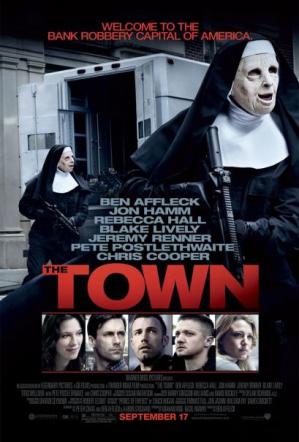

I missed out on The Town a couple years ago when it was a big mainstream success and all that.  It's not really the kind of movie I'd typically be interested in, but a combination of crazy good word of mouth and my excitement over seeing Argo finally caused me to cave.  And you know what?  I'm glad I did.  It's a solid and satisfying movie all around, even though we've seen much of it in other movies before.

Ben Affleck stars as Doug MacRay, the leader and mastermind of a ring of Boston bank robbers.  They take the manager, Claire (Rebecca Hall), hostage in the opening heist, and Doug lets her go without hurting her.  He knows that his unstable best buddy Jem (Jeremy Renner) will kill her if she can identify them, so Doug keeps tabs on her, and they strike up a relationship.  Now Doug must keep Claire safe, keep Jem in check, dodge Jon Hamm and the FBI, who are hot on his trail, and plan and execute his next heist under their noses, all while experiencing deep reservations over the life of crime he's chosen for himself.

Affleck really knows what he's doing, if you're wondering.  He had a good script in his hands (which he helped write), surrounded himself with a great supporting cast and crew, and directed the hell out of this thing.  The heists are smartly executed and exciting, the characters are all around interesting and engaging, with layers of conflict between them.  Jeremy Renner steals the show, but everyone is good.  Yes, I would say that Affleck has given his career a second leg that will have much more staying power than his Bruckheimer years.  And good for him. 

 --------------------------------------------------

Well, I kept them both mercifully short today.  I've just been so busy!

Wednesday, August 29, 2012

Three Early British Thrillers: Night Train to Munich, Sabotage, Secret Agent

Night Train to Munich, by Carol Reed, 1940

Even though the James Bond movies may have defined the spy genre over the last fifty years, the British had been making great spy movies for decades before that. Night Train to Munich is just one example, directed by the great Carol Reed, who also brought us the post-war masterpiece The Third Man and the Oscar winning musical Oliver!

Night Train to Munich is the story of Anna (Margaret Lockwood), the daughter of a scientist wanted by both the Germans and the English. She and her father are kidnapped by the Nazis, and a dashing secret agent (Rex Harrison) goes undercover as a German officer to rescue them. They hatch a plan together to escape Germany to the Swiss border. Along the way, they get help from Charters and Caldicott, two comical Brits who seem to find themselves in interesting train adventures all the time (they previously appeared in the same roles in Hitchcock's classic The Lady Vanishes, which also features Lockwood in a different role).

The movie is an intelligent, sometimes tense, sometimes funny, thriller. Harrison and Lockwood have a great "I know we hate each other but we have to pretend we're lovers" chemistry going on. Basil Redford and Naunton Wayne provide a bit of comic relief, but also give the audience an everyman perspective on these extraordinary events. It had been years since I've seen The Lady Vanishes, so I forgot that they were the guys from that too, but I think that's totally awesome. The climax, set high in the Alps at the Swiss border, is an action packed shootout revolving around those cable cars that carry you from mountain to mountain. I won't blow the details, but it's a fantastic ending.

Sabotage, by Alfred Hitchcock, 1936

And speaking of great British thrillers, let's move right on to the absolute master. Sabotage is a fairly early Hitchcock film, made not long after he had found international success with The 39 Steps, a good couple years before he repeated that success with The Lady Vanishes, and four years before he moved to Hollywood and became THE Alfred Hitchcock with Rebecca.

Sabotage is the story of a terrorist placing bombs around London while Scotland Yard tries to hunt him down. What is extremely interesting, especially for its time: Hitchcock paints the terrorist as a normal man, hiding among us, a European immigrant with a loving wife, whose younger brother lives with them and looks up to him. We, the audience know his motives all along, though his family is oblivious, which is where much of the suspense is mined from.

Though not Hitchcock's best work by any stretch, we do see a lot of the tricks and techniques that will later become his trademarks. The story itself is pretty daring and he doesn't wimp out when it gets to the climax. My favorite piece of Hitchcockery in the film is when the terrorist sends his wife's brother out with a package, which, unbeknownst to the boy, contains a bomb. He shoots a close-up of the package, overlaid with a shot of gears turning, and then a shot of a clock ticking.

Sabotage is a really cool movie, made at a time when Hitchcock was still defining himself. His voice isn't entirely clear yet, but you can watch him as he figures it out. He would, of course, go on to make many of the greatest suspense thrillers ever. If you've seen a bunch of those, and still want to dig a little deeper, this would not be a bad place to start.

Secret Agent, by Alfred Hitchcock, 1936

I guess I already covered a lot of what I would say about Secret Agent in Sabotage. It was made in the same year as Sabotage, though it seems to be more following on the heels of The 39 Steps. Where Sabotage is darker and edgier, Secret Agent is a spy adventure.

John Gielgud stars as a writer sent on a spy mission, along with two other agents, one pretending to be his wife (Madaleine Carroll), and Peter Lorre as a Mexican, or possibly just a guy who is called a Mexican. Lorre was my favorite part of the film. He was such a great character actor, and this was very early in his English language career (which Hitchcock started two years before with The Man Who Knew Too Much).

I didn't enjoy Secret Agent as much as Sabotage, though it, too is one of those early films where you can see Hitchcock developing right in front of you. Many early examples of his techniques are on display here too. This is probably one for the hardcores only. If you want to be a Hitchcock completist, Secret Agent has its moments for sure, but many of those moments appear in later (and a few earlier) movies with much better execution. This guy made a lot of amazing movies, arguably more than any other great director, so go watch ALL those first, if you haven't already.

Thursday, May 3, 2012

The Grifters

Making a good Con Man movie at this point is no easy task. It's always fun to watch con artists pull off a job, but the genre itself is riddled with cliches. I get so tired of when you find out that the con man hero was actually being conned the whole time, by his partner or mark. That was a funny and original twist thirty years ago in Dirty Rotten Scoundrels, but a tired old gag by the time it turned up ten years ago in Matchstick Men.

The Grifters is, thankfully, different from the typical con man movie. In fact, it's not like any I've ever seen. It is less interested in the act of deception and more interested in getting inside the characters and exploring the reasons why they make a living out of deceiving. Produced in 1990 by Martin Scorsese, and directed by Stephen Frears, The Grifters is a dark and gritty look at what makes the con artist tick.

John Cusack stars as Roy, a young grifter who focuses only on the small game. He learned from his mentor never to pull a long con, never to work with partners, and never to get caught. Unfortunately, he's maybe not as good as his mentor. At the start of the movie, he gets caught by a bartender he attempts to rip off and takes a baseball bat to the gut, resulting in his hospitalization for internal bleeding.

This brings his mother, Lilly (Anjelica Huston), out of the woodwork. She works at a horse racing track for a dirty bookie, betting on horses in order to mess up the odds. Lilly had Roy when she was only 14, and never has fully forgiven him for ruining her life. The feeling is mutual. Roy has issues with her methods of parenting as well.

Roy's girlfriend, Myra (Annette Bening), is also in the game. Though in her glory days, she worked long cons with the big guys, she now also works small time, largely relying on sex to get the job done. There is an instant dislike between Myra and Lilly upon meeting.

What follows is a story of deception and betrayal, as the three characters demonstrate just how far they will go to get what they want. I loved that there wasn't a "mark" or a con that they all team up to pull on somebody. It was all about the three of them.

In the case of Cusack, he's not willing to go quite as far as the women. He doesn't really have what it takes to be in the game, and that's what makes him likeable, and maybe is why his performance is not as well regarded as Bening's and Huston's, who both got Oscar nominations. He really is just as good as they are, though. This was made not long after Say Anything... with Cusack hungry for the big leagues and ready for more grown-up roles.

As said before, Annette Bening and Anjelica Huston are fantastic as well. They take each of their characters to really dark places. Moreso than with Cusack's character, who really just wants to be loved by his mother, you see through them the kind of damaged person one must be to make a life out of lying.

Stephen Frears is an extremely talented director who has made some great movies in a wide range of different genres. He is perhaps best known, in addition to The Grifters, for directing another John Cusack classic, High Fidelity. These two work together excellently. I'd go so far as to say Frears is the best Cusack director there is. They should make another movie together, it's well past time for that.

I laid off talking about the actual plot of The Grifters, because there are some twists and turns and it actually took me by surprise. The story did not play out remotely how I expected it to, and I mean that in the most complimentary way possible. It's rare and refreshing to see a Con Man movie that doesn't fall back on the usual devices of the genre.

Tuesday, May 1, 2012

Rebecca

After a series of successful thrillers in England, Alfred Hitchcock made his way to America in 1940 to make movies for Hollywood. He hit the ground running with Rebecca, an adaptation of a recent bestselling novel that earned him a Best Picture Oscar.

Rebecca stars Joan Fontaine as a timid young woman who works as a personal assistant for a domineering old rich lady, vacationing in Monte Carlo. Fontaine (whose character is never given a name) soon falls in love with Maxim de Winter (Laurence Olivier), an aristocrat spending time away from his manor after the death of his wife, Rebecca.

He soon proposes to her, and they return to his mansion, Manderley. Manderley is an unsettling place, a shrine to Rebecca, where all of her things remain untouched, and not a moment passes where the servants, especially the cruel Mrs. Danvers, compares Fontaine unfavorably to the former Mrs. de Winter. Maxim will not speak of Rebecca at all, and flies into a fit of rage when reminded of her. Soon, the presence of Rebecca weighs heavily on Fontaine, pushing her into despair, and ultimately, a confrontation with Rebecca's past.

Rebecca is a quintessential Hitchcock movie, in which he explores how people can often be in the control of other people. Even the dead can hold sway over us. It's a ghost story without an actual ghost. I love the techniques Hitchcock employs to make Mrs. de Winter seem insignificant. In addition to keeping her character nameless, he also made everything in Manderley seem way too big for her. The house itself oppresses her, with huge doorways with handles so high that she has to reach up to open them. Even in a low angle, the walls are so high that they stretch endlessly above the top of the frame. We are given no hint of a ceiling.

The entire cast is great, but Rebecca is Joan Fontaine's movie all the way. She begins the movie young and clumsy and eager to please, full of innocence but with very little self worth. By the end of the events of the movie, she is transformed into a different woman, innocence gone, but walking taller.

I won't spoil the story for those of you who aren't familiar with it, but there is a twist in the third act, that sets the entire story into a different direction. The twist is smart and surprising, and I certainly wanted to see how the rest of the story played out, but the third act is never quite as enthralling as the first two. There's absolutely no way I'm the first reviewer to say it like this, but the first two acts of the movie overshadow the third, much in the way that Rebecca holds sway over the new Mrs. de Winter and Manderley.

Rebecca is still great, though. Hitchcock was already making great movies by this time, but this movie pushed him up to another level.

Friday, February 17, 2012

High and Low (Tengoku to Jigoku)

Every once in a great while, one has that feeling while watching a movie that they are watching one of the best movies they have ever seen. It's a thrill, and naturally, the older I get and the more movies I see, the less frequently I experience this rush. But as luck would have it, there are still a whole bunch of Akira Kurosawa movies out there that I have yet to watch.

High and Low, my eighth Kurosawa film, and the first I've seen set in the present day (1963, that is), is many different films at once. A kidnap thriller, a police procedural, a morality tale, and an examination of class disparity, and it's all filled with the same compassion and humanity that Akira Kurosawa brought to everything he made.

The story opens with Gondo (the legendary Toshiro Mifune), an executive for a shoe company, who is poised to take over the company and oust the other men on the board, who want to make cheaper shoes and charge more money for them. After a meeting with these men goes sour, he gets a telephone call, where an unknown voice tells him that his son has been kidnapped and demands a ransom of 30 million Yen. It quickly becomes apparent that it was not his son that was kidnapped, but rather the son of his chauffeur. The kidnapper tells Gondo that he must pay the ransom anyway, and Gondo must now come to the decision: must he give up his entire fortune for another man's son?

The first hour of the movie is almost like a play, the drama rarely leaving Gondo's home. What is truly amazing about this first hour is the way it's shot. Kurosawa uses long takes, sometimes 5 minutes or more, each shot carefully composed to maximize the emotional impact of what the characters are going through. He shows a mastery of spacial dynamics between the characters, often making social statements just with where they are positioned compared to each other in the frame.

Then, an hour into the movie, it makes an abrupt and complete change. The action leaves Gondo's home, and the focus shifts almost completely away from Gondo, over to Detective Tokura (Tatsuya Nakadai, the star of Kagemusha), the man tasked with hunting down and arresting the kidnapper. He and his team are good detectives, and what follows is a fascinating police procedural, as we watch them solve the mystery.

Amidst all this is a very large social statement. We learn that Gondo's large, air conditioned (a luxury at the time) home is located high atop a hill over the city of Yokohama, seemingly arrogantly looking down on the poor people below, sweating and suffering during a summer heatwave. There is a sense of local resentment toward Gondo and his place in society. Eventually, we follow the detectives and the kidnapper (played brilliantly and almost silently by Tsutomu Yamazaki) into the lowest place in the city, where heroin addicts lay in the gutter and writhe in agony.

I could go on and on how incredible High and Low is, but then you wouldn't really have any reason to watch it yourself. Kurosawa is, in my estimation, the greatest filmmaker who ever lived, and this is right up there with Seven Samurai and Rashomon as one of his greatest achievements. And those are just among the ones I've seen!

Monday, January 30, 2012

Murder a la Mod

I know I said in my Blow Out review that I wanted to watch more Brian De Palma films, but this isn't what I meant. Murder a la Mod was one of De Palma's very first films. It was possibly a student film. I don't know, I couldn't find out for sure. Anyway, I'm going to keep this one short and sweet, because I really only watched this because it was a special feature on the Blow Out Blu Ray.

Murder a la Mod is not very good, but you can see throughout early versions of a lot of the techniques that eventually come to be known as De Palma's "style". Some scenes with an unsettling sense of voyeurism, some of his weird, hit or miss (mostly miss in this case) sense of humor, and importantly, much of the second half of the movie is the same sequence of events repeated from several different characters' perspectives.

Like Blow Out, Murder a la Mod is a tale of murder set in the world of filmmaking. A key sequence involves the swapping of a real ice pick and a movie prop ice pick that retracts into the handle. The lead guy from Phantom of the Paradise, William Finley has a pretty big role as a weird prankster character who spastically narrates everything he does in his mind. It's pretty bad. But he also wrote the theme song, which is a pretty rollicking piece of 60's garage rock. In fact, the theme song was my favorite part of the movie.

There are a couple of interesting moments, but Murder a la Mod is, like a lot of directors' first films, really only relevant due to what came after them. The seeds are there. It's definitely De Palma. But I see no reason for anyone to watch this unless they're a completist or something.

Blow Out

I've always been kind of back and forth on Brian De Palma. Granted, I haven't seen too many of his films, so I've never really given him a fair chance. I was touched by Carrie, but I never cared for The Untouchables. Things started to turn a little in his direction for me a few years ago, when I saw Phantom of the Paradise, his truly bizarre cult glam rock musical with a soundtrack composed by Paul Williams. Last week, I finally watched the movie that many say is De Palma's finest and most underrated work, Blow Out.

Blow Out stars John Travolta as Jack, a sound effects man for a trashy independent movie studio. The movie opens with a hilariously cartoonish parody of Halloween, a steadicam shot from the perspective of a heavily breathing serial killer entering a girls' dormitory. This, of course is the movie Jack is working on. His boss is unsatisfied with Jack's work, and tasks him to find a new scream for the victim and record some new wind audio for the background.

While at a park recording the wind and nature sounds, Jack is witness to a car's tire blowing out and crashing into a lake. He jumps into the water, and though the driver is clearly dead, he sees the woman in the passenger seat still lives and rescues her. At the hospital, he learns that the man who died is the governor of Pennsylvania, who was primed to run for president. His people request that he keep quiet about the event and aid them in covering it up by sneaking the woman, Sally (Nancy Allen), out of the hospital for them. Jack reluctant agrees to do it.

Jack takes Sally, still in shock from the accident, to a motel. While she's out of it, he listens to his recording. In it, he hears two distinctive sounds: not just the sound of the tire blowing out, but a loud bang preceding it. Jack then enlists Sally's help in uncovering a political murder conspiracy, though they are blocked in seemingly every direction they attempt to investigate. Meanwhile, the man who shot out the tire (John Lithgow) is cleaning up the mess he made: by making it appear that a serial killer is on the loose killing prostitutes who resemble her, he will murder Sally and make it seem like she is a victim unconnected to the governor.

Wow, that's a pretty intricate story with a lot of set up. I usually don't need more than one paragraph to give a decent description, but this one took three. What De Palma has crafted with Blow Out is a tragedy wrapped in a conspiracy. As we learn more about Jack's past, we begin to understand his desire to play the hero in all this mess. And Sally, who is not entirely clean herself, gets wrapped up in Jack's futile idealism.

Stylistically, De Palma employs all of the tricks he had been developing through the 70's. He plays with seeing the same scene from different perspectives. He utilizes split screen like nobody else. He does that thing where the foreground of the shot and the background of the shot are both completely in focus, which causes an excellent, jarring effect on the viewer. I don't know what that technique is called, but it's in Blow Out a lot and it looks great. De Palma used Vilmos Zsigmond as his cinematographer, and Zsigmond gives the film a dark, seedy look, with lots of red lights and stuff.

This is probably my second favorite John Travolta performance I've seen, behind Pulp Fiction. I'm not a huge Travolta fan for the most part, but every once in a while, he takes just the right role for himself and runs away with it. John Lithgow is great as usual, but this is really the type of villain role he could do in his sleep.

The score by Pino Donaggio is a pretty mixed bag for me. Some of the music was really unique and underlines the tension and growing sense of paranoia, but at other times, I think it goes way too dramatic and over the top.

I won't give away the ending, but De Palma himself might. If you catch on early enough in the movie, you can see where it's headed. I was pretty in-the-moment when I was watching, so I wasn't really thinking ahead, but my wife totally saw it coming. Still, the ending is appropriate and unsettling. I can see why the movie failed to capture an audience upon its release. Also, that poster up there is pretty terrible, so it might have something to do with that.

I still haven't seen a lot of Brian De Palma's films, but this is probably the best I've seen. Phantom of the Paradise is still my personal favorite for it's craziness and music, but Blow Out is definitely the better movie. He's show-offy and often not very subtle, but he doesn't come across as pretentious to me, which can make those traits tolerable, even endearing at the best of times. I believe I will be checking out more of De Palma's films in the future.

Monday, January 23, 2012

Hanna

Joe Wright's 2011 film Hanna could have been pitched as The Bourne Identity meets Kramer vs. Kramer. It's basically about a young girl caught in the middle of a very messy divorce. The girl just also happens to be a genetically modified kung fu killing machine.

At the opening of the film, we meet Hanna (Saoirse Ronan, I promise to learn how to say that out loud someday), a teenage girl living in the Northern European wilderness with her father (Eric Bana), cut off from the civilized world. He has devoted his life to teaching her combat, hunting, survival skills, languages. You know, spy stuff. When she comes of age, and begins to wonder what the world outside their forest is like, he gives her the option to leave, though it will alert the CIA, the agency he has been hiding her from all these years, of their existence.

They split up, agree to meet up at a specified rendezvous point, and both go on the run. Hanna is soon captured by the CIA, led by the villainous Cate Blanchett, spiteful of Bana's character's defection and kidnapping of Hanna after all these years. Hanna escapes in a really cool little sequence where you see her life of training put to the test, and leads them on a chase across Europe. Along the way, she befriends an oddball family of English Bohemians and learns what it's like to be a real person.

I really thought I would like this movie better than I did. The first half hour or so, all the way through Hanna's escape from the secret CIA facility, had me locked in. From that point on, the movie kind of lost me, only pulling me back into the story once in a while. Joe Wright, best known for period dramas that I've never seen but might look into someday, such as Atonement and Pride and Prejudice, seems to be doing his best to bring a dynamic, somewhat artsy kind of visual style to the story. It's kind of reminiscent of Danny Boyle in his more hyperactive mode. Combined with a thumping score by electronic artists The Chemical Brothers, the action sequences are propulsive and as relentless and violent as a PG-13 film will allow.

Saoirse Ronan is very good as Hanna. It's fair to say she will be around in movies for some time to come. Hanna speaks English with a German accent. I wondered to myself if Hanna was ever taught German, or if she just knows English with a German accent, since she speaks to her father in English in all of their private scenes together.

Cate Blanchett, on the other hand, made what I think was a very big mistake with her character in giving her a southern accent. I don't know if it was scripted that way, or her idea, but for some reason, it seems to me like something she would bring to the table herself. It's the kind of accent that, I don't know, might pass muster outside of America, but sounds pretty bad to us. She's done decent American accents before. I guess she just really wanted to play a Texan.

Despite it's problems, Hanna had some fun sequences and a good soundtrack to keep it going. I appreciate that Joe Wright seemed to really want to give us something different, it just didn't quite get there for me.

Thursday, January 19, 2012

Tinker Tailor Soldier Spy

Hey, I'm back! Sorry I haven't been writing many reviews lately. No excuses, just being lazy. I still love you, though. Don't let anyone think otherwise.

Today's review is my first non-James Bond review of 2012. Ironically, it's the opposite of a James Bond movie: Tinker Tailor Soldier Spy, Tomas Alfredson's adaptation of John le Carre's classic espionage novel. The story, set in the 70's, follows George Smiley (Gary Oldman), a disgraced British Intelligence officer who is forced into retirement after a botched operation, and then called back in to weed out a Soviet mole who has infiltrated his way up to the very top of the system. They have narrowed him down to one of only five men.

Smiley was conceived as the complete antithesis of James Bond. He is an over-the-hill cuckolded bureaucrat. Being a spy is not romantic at all in this world. Gary Oldman is excellent in the role, very understated and unassuming which are qualities much more suitable for a secret agent, if you ask me.

Tomas Alfredson, whose first film was the beautiful adolescent vampire romance Let the Right One In, directs Tinker Tailor Soldier Spy with a muted, melancholy touch. The cinematography is top notch, and the acting is some of the best I've seen in 2011. In addition to Oldman, the cast includes Mark Strong, Benedict Cumberbatch, Toby Jones, Colin Firth, and Tom Hardy. Their performances are all as understated as Oldman's, though, and generally, the awards folks like things to be a little bit showy, so I'm not surprised that this movie is getting pretty much passed over by everyone.

As for the story, well, it's pretty dense and murky, and requires the viewer's utmost attention and patience. I admit that I may not have been able to follow it entirely, but I saw that as a plus. It's rare that a movie comes out that requires the viewer to work. I enjoyed trying to puzzle it all together, but much of the audience at the theater I was attending seemed completely turned off.

I'm going to go out on a limb and say Tinker Tailor Soldier Spy is not for everyone. Personally, I enjoyed it, though it did take a while to really get going. I would very much like to read the novel that it's based upon and then watch the movie again, and see if and how that will alter my perception of it.

Thursday, December 29, 2011

The Girl with the Dragon Tattoo (2011)

My wife was actually much more excited to see David Fincher's adaptation of The Girl with the Dragon Tattoo than I was. Don't get me wrong, I wanted to see it. I want to see any new David Fincher movie. But I get nervous about seeing movies with particularly brutal violence, such as rape and torture. Sometimes I chicken out entirely. I've got to say, though, I'm glad I didn't chicken out, because I found that I enjoyed the movie way more than I thought I would.

For those who don't know, The Girl with the Dragon Tattoo is a murder mystery thriller about Mikel Blomqvist (Daniel Craig), a recently disgraced Swedish investigative journalist hired by an old millionaire (Christopher Plummer) to figure out who in his family murdered a niece he was close with 40 years prior. His life soon collides with Lisbeth Salander, a tough, brilliant, but emotionally shut-down hacker who has been more than once been sexually and physically abused by men in her life.

So, was my initial hesitance justified? Not really. Well, kind of. There are multiple rape scenes in the movie, and they're pretty intense and brutal and not for the weak of heart. But whenever I'm nervous about a movie like this, I almost always find that my constitution for this sort of thing on film is a lot stronger than it is in my imagination.

I've read the original Stieg Larsson novel that this movie is based on, but I haven't seen the original Swedish film. I should probably check it out, I suppose. I liked the novel but didn't love it. It was definitely a page-turner when the thriller aspect was going, but there were long stretches that I just didn't find all that interesting. David Fincher actually did a great job of weeding out those parts. There are several scenes of them simply researching old photos and files, but Fincher manages to draw you in and keep it engaging. The story actually continues in the book for 150 pages or so after the huge climactic mystery-solving scene. In the movie, that stuff is thankfully reduced to about a half hour or so. It's still a lot of movie after the story is seemingly over, but I felt like it really drove home that the story is more about the relationship between Blomqvist and Salander than the murder they're investigating.

I liked Daniel Craig and Rooney Mara in the leads. I'm unable to compare the two of them to the original actors who played them, which may have worked to my benefit. My wife has seen the original and she says both sets of leads are good in different ways.

The Girl with the Dragon Tattoo is a pretty great thriller, and it grew on me even more over time. I've probably thought about it more than I've thought about all the other movies I've seen the last few weeks. Zodiac is my favorite of all of David Fincher's films (in fact, one of my favorite films of the last decade), and I think he applied some similar techniques to this film. Certainly the whole making research interesting thing.

If you're not a movie wuss like I am, you should totally check out The Girl with the Dragon Tattoo. Even if you are, maybe you should give it a shot. I did, and it totally paid off. I hope that it does well enough and that they can lure Fincher back for the sequel, because the story is a great match with Fincher's sensibilities, and Lisbeth Salander is a truly unique and interesting character.

Saturday, November 5, 2011

Rope

One of the things I love most about Alfred Hitchcock is the way he would find ways to challenge himself. Sure, he mostly stayed within the thriller genre, so there was always the relative safety of knowing he's doing what he does best. But Hitchcock would sometimes find ways to intentionally restrict himself as a director, such as limiting his camera's perspective to only that which his protagonist could see, in Rear Window.

Rope is Hitchcock at his most experimental, taking away from his arsenal what is perhaps the most important tool a director has for building suspense: editing. Rope is a story told in (seemingly) a single shot. The limitations of the time, specifically the length of a reel, forced him to hide a cut in there every 10 minutes or so. What does Hitchcock do without editing? He finds a million other ways to increase tension.

The story follows two old prep school chums, Brandon and Phillip, who in the film's opening, have just finished strangling a man (David, a third "chum") to death. Brandon believes they have committed the perfect crime, Phillip is not so sure. All that's left to do is to wait until dark, and take the body out to the country to dispose of it.

It's not going to be that easy, though, is it? Brandon is so cocky and brazen, his head so full of philosophical justifications of his own intellectual superiority, that he can't help but see just how far he can dangle his accomplishment over everybody's heads without them catching on. The best way to do that? Throw a dinner party before they go, the guest list full of associates and loved ones of the victim himself.

Among the guests are their housekeeper, David's girlfriend, his father and aunt, the 4th chum in their Chummery, and Rupert, their old teacher, the one who filled Brandon's head with these philosophical notions (played by Jimmy Stewart). James Stewart is the biggest name in the movie, so you know he has a meaty role.

Brandon takes every chance he possibly can to drop little hints of what he and Phillip did in front of the guests. Phillip is just trying to keep it together. Rupert can see that something suspicious is going on, and is putting the pieces together. It's pretty much one of Hitchcock's "perfect murder" setups, where a character starts off thinking they're secure, and we get to watch as their schemes slowly crumble do to a missed detail here and there.

The fun of the movie is in Hitchcock's inventiveness in finding tension and suspense without edits. The camera swoops all around the apartment, following different conversations as they happen in real time, and panning in on objects, letting the audience in on details that the characters may not be aware of yet. The music is only source music, never soundtrack, and it is provided by the jittery Phillip, nervously fumbling through an off-kilter, lilting piano tune.

The lighting is pretty masterful, as well. Set in a New York high rise, the movie uses a phony backdrop of the New York skyline outside. The movie is set at dusk, though, so with some clever trickery, the backdrop is replaced with darker and darker ones as the sun sets. Things reach a crescendo when the blaring neon lights on the building across the street burst on, washing the room in anxious reds and greens.

Some of the edits in Rope are more subtle than others. Most of the time, Hitchcock just pushes in on the back of an actor's jacket and hides the cut there, where the screen is all black. There's a particularly seamless one early in the film, where he cleverly overlaps the sound of piano and dialogue from the next shot in with the previous.

Rope is more known for its gimmick than its content, but I found the story to be quite entertaining. Jimmy Stewart is always fun to watch, isn't he? Hitchcock was the master of pulling our strings, and there's a subtle psychology to the way he would put together a story, especially within his editing. It's interesting to see that he was just as able to mess around with us without the benefit of his greatest tool as he was with it.

Saturday, October 1, 2011

The Bad Seed

It's October, everybody! I'm sure most of you know what that means. That's right, horror movies. I'll be watching as many as I possibly can over the next month, so keep checking back!

The first movie in my month-long celebration was the classic 1956 evil kid thriller, The Bad Seed, directed by Mervyn LeRoy, and based on the play of the same name, which was based on the novel of the same name. Like all movies from the 1950's, it's about the Penmarks, a happy, loving family with the sweetest little girl in the world. For the first five seconds, anyway, because the very moment you meet little Rhoda, you can tell something's off with her. She's just a little too sweet. It's got to be an act.

It doesn't take long before her true colors are revealed. When the matter of a penmanship award she lost to another kid in class is brought up, she goes batshit. Then, when Leroy, the simple groundskeeper they employ sprays her feet with his hose, she flips again. Leroy isn't fooled by her act, though. He can see right through her with his powers of simplicity.

While Rhoda is away at a school picnic, her mother, Christine, while entertaining company, hears on the radio that a child has drowned at the park. Afraid at first that it was Rhoda, she is relieved to hear that it was another child. But when Rhoda comes skipping into the house like nothing has happened, Christine is more than a little bit unsettled. She talks to Rhoda about it and Rhoda doesn't seem phased by it in the least; she just wants a peanut butter sandwich.

Fuel is further added to Christine's suspicions when Rhoda's teacher comes to visit her, and she learns that the child that drowned was the little boy that Rhoda lost the penmanship award to. On top of that, Rhoda was seen fighting with the little boy on the dock that he fell off of. Aw, crap.

I won't go any further than that. The Bad Seed is meticulously and cleverly plotted, and I don't want to ruin too much, in case I've already convinced you to watch it. If you need more convincing, I'll say this: the little boy isn't the last person to kick the bucket.

The acting is really great, especially the little girl, who, along with Nancy Kelly as Christine, and the lady that played the grieving mother of the little drowned boy all got Oscar nominations. I honestly wasn't expecting the acting to be so good. I just expected a campy 50's B-movie. The screenplay based on the play based on the book is solid and entertaining. Whoever wrote it must have done their research on psychopathic behavior, because little Rhoda fits the description to a tee. The cinematography, also nominated for an Oscar, does something very difficult to pull off: keeps the storytelling fresh and interesting, even though the majority of the movie is confined to one small set.

The 1950's offered a particular challenge for filmmakers: finding ways to tackle mature subject matter, without falling under the scrutiny and censorship of the Hayes Code. There is a certain slyness in the best films of the period, like, say, how smartly Billy Wilder's The Apartment dealt with suicide. The Bad Seed is plenty subversive, but even it ran into some walls. The original, much darker, and more appropriate, ending had to be changed. I think they did a decent job with the new ending, but now knowing how it should have been, I have to say I would have preferred that.

After the movie is over, there are still a couple more surprises. First, a card comes up, entreating the audience not to spoil the ending for others. How cool is that? It would be pointless to even try to ask people not to ruin endings nowadays, since all the information is readily available before the movie even comes out. After the card, we're treated to a final curtain call of the cast, each taking their bows, smiling, and with good humor. It's really funny, especially the very end of it, with Rhoda. If you don't already know about the last shot in the credits, I won't ruin it here. Watch the movie!

Wednesday, September 28, 2011

Killer's Kiss

As I mentioned in my previous review for Stanley Kubrick's film, The Killing, his previous film, Killer's Kiss, was included on the special features of the Blu Ray. It was very nice of Criterion to do this, since many would consider it worthy of a release of its own.

Killer's Kiss follows Davey, a boxer, who at the start of the movie loses a big fight. He meets a dancer named Gloria, who is dealing with her abusive boss always forcing himself on her. The two of them decide to run off together, but she gets kidnapped by the boss, and Davey gets a murder pinned on him. It all comes to a head with an exciting chase sequence and a showdown with sharp objects inside a creepy old mannequin warehouse.

That's about it for the story. It's not even really a story in any kind of linear sense. There are several diversions in the narrative, like Gloria's story about her ballerina sister. Gloria narrates the whole story over a long ballet dance. Killer's Kiss has a real stream of consciousness feel to it, like Kubrick was making it up as he went along. In some sense, he probably was.

Killer's Kiss was made independently by Kubrick with a little bit of money he borrowed from an uncle. He shot it in the streets of New York, using what was available to him. No elaborate sets, or crazy attention to detail here. He's just grabbing shots whenever and wherever he can. As a result of this, Killer's Kiss has a realism not generally found in his later films. You really get a sense of how run down and seedy the Times Square area was in the 50's.

The final chase and showdown is pretty badass. From the way it started, I didn't expect the movie to get so exciting at the end. The rooftop chase has some extremely real moments, one where one of the crooks trips and falls and gets back up. I assume that Kubrick just kept that in. At another point, one of the guys hurts his leg and can't go on. I think this was just to get the boss guy alone with Davey, but still, that's not something you see in very many action movies. The mannequin factory showdown is crazy, too. The boss guy has an axe and Davey has this hook thing that he's catching it with. All the while, Kubrick is cutting away from the fight to show us creepy, foreboding shots of severed mannequin heads and hands. Really cool stuff.

While not quite as good as Kubrick's later work, you can see the seeds of what he was to become in Killer's Kiss. The running time is crazy short, just a bit over an hour. It's kind of noir-ish, but without much plot to speak of. The dialogue doesn't pop like it did in The Killing. Still, it's an enjoyable little thriller, and worth watching just to see the humble beginnings of a cinematic giant.

Tuesday, September 27, 2011

The Killing

Recently, I purchased the Criterion Collection Blu Ray of Stanley Kubrick's classic racetrack heist film noir, The Killing. This was my first time seeing it, as well as his previous film, Killer's Kiss, which is also featured on the Blu Ray.

I've seen I guess about half of Kubrick's films now, maybe a little more than that, but The Killing was the first one I've ever seen that feels, you know, kind of mainstream. It follows a group of guys plotting to steal $2 million worth of betting money at a racetrack. Besides Johnny, the mastermind, these guys aren't criminals, just normal guys who have some unfortunate circumstances in their lives to motivate them. Each have an important role to play in the heist itself.

The first two acts follow the plotting of the heist, as Johnny gets all of the pieces in line. We also see all of the guys at home, and learn what is driving them. One of them, George, is a pushover in a loveless marriage. If they remade this, he would be played by William H. Macy. Hoping for a little bit of respect, he tells his wife what's going on, and she, in turn, tells the guy she's sleeping with on the side, and they hatch a little plot of their own.

The third act is, of course, the heist itself. It's pretty brilliantly staged, where we see one guy perform his duty, and then jump back in time a bit to see what the next guy does. Though techniques like this are not rare for slick heist movies now, it was pretty unique for the 1950's. It reminds me, surely not coincidentally, of the third act of Quentin Tarantino's Jackie Brown.

I won't spoil the ending, of course, other than to say that things do get bloody. Do they get away with the robbery? And then what after that? It has one of my favorite endings I've seen in a long time. The last line of dialogue is killer.

Even though it was still very early in his career, Stanley Kubrick's presence is still very much felt. The lower budget probably prevented it from having the ridiculously exacting detail that Kubrick later obsessed over, but the cinematography is still great. The acting is good, too. Little flourishes and details in their performances make the characters seem far more human than a lot of other movies from this time did. My favorite character was probably the sharpshooter Johnny hires to take down a horse to cause a distraction. When we meet him, he's demonstrating his skills by shooting a string of man-shaped targets. When he's done shooting, Johnny hands him his little dog back and he plays the rest of the scene cradling a puppy.

I really enjoyed The Killing. It was noir all the way, with razor sharp dialogue, but not so dark as to be depressing. The heist was truly fun to watch play out. It was interesting to see a young Kubrick at work, and I admit, even a bit of a relief that it wasn't as esoteric as his later work tended to be. And this is coming from a guy whose favorite Kubrick film is cinema's greatest riddle, 2001: A Space Odyssey. See it if you haven't already!

Monday, September 12, 2011

Contagion

I've been a fan of Steven Soderbergh since, wow, since Out of Sight came out, which was when I was 15 or 16, right at the onset of my burgeoning deeper interest in filmmaking. I would even go so far as saying Soderbergh played some part in my deeper interest. I haven't seen all of his films, but I've seen many of them, and with the exception of maybe the Ocean's sequels, they've all been good (and even the Ocean's sequels have their share of moments). I guess I'm saying all this to illustrate that I know I'm in good hands when a Steven Soderbergh film comes out, and that sentiment again proved true with Contagion.

Contagion is much like his Oscar-winning epic Traffic, in that, instead of a single straight narrative, it follows several characters from around the globe, tracking the progress of a fast-spreading new virus as it tears its way across the world. Unlike Traffic, though, Contagion plays more as a thriller or even a Chrichton-esque horror movie. It never goes too far into the realm of science fiction, keeping the situation grounded enough in reality to be believable and genuinely scary.

Matt Damon plays the relatable human side of the movie, as a man whose family are among the first victims of the virus, trying to protect his daughter from sickness and all the other dangers that could come from a world ravaged by plague. He's good as always, I really can't think of anything bad to say about Matt Damon in anything, especially his work of the last five years or so.

Contagion also stars Laurence Fishburne as the head of the CDC, Jennifer Ehle as a CDC researcher working on a cure, Kate Winslet as an epidemiologist searching for the origin of the virus, Marion Cotillard as a World Health Org. investigator, and Jude Law as a corrupt blogger, profiting from the panic he's helping stir up. Many other good actors appear in smaller roles, too, such as Gwyneth Paltrow, John Hawkes, Bryan Cranston, Enrico Colantoni, and so on.

Soderbergh and the writer, Scott Z. Burns, clearly did a lot of work to show how an outbreak might actually spread and what might happen as we race to find the cure. It takes place over a pretty long period of time, since it wouldn't be realistic for a cure to be found and distributed overnight. I'm pretty sure they used the recent Swine Flu epidemic as their jumping-off point. Soderbergh uses some extremely cool editing to show the virus' progress via montage. The montage stuff was probably my favorite stuff in the movie.

So Contagion is totally worth checking out. Steven Soderbergh once again proves himself a capable and versatile director. I think he's made movies in almost every single genre by now. Besides, with all this talk of him retiring in the next couple years to become a painter, we should try to enjoy Soderbergh in theaters while we can.