Showing posts with label 1980's. Show all posts

Monday, October 15, 2012

The Brother from Another Planet, The Town

Hey, everyone!  I'm almost to my October movies.  I just have a couple short reviews here, (and I mean short) and a couple of reviews catching up on new releases, and then it's pretty much just horror for the remainder of the month, and probably spilling well into November, too.  I love this time of year!

The Brother from Another Planet, by John Sayles, 1984


This is an interesting movie.  The Brother from Another Planet is the story of an escaped alien slave who flees to earth and finds his way to Harlem, while the men in black (who are white aliens posing as immigration officers) try to track him down.

The alien is played by Joe Morton, best known (by me, anyway) as Dyson in Terminator 2.  He has difficulty speaking in human language, so he remains mute for the whole movie, but Morton still conveys a lot in his silent performance.  He's gentle, and curious about humans, and all their flaws.  A lot of people take a shine to him even though he doesn't talk.  He has a knack for fixing electronics like TVs and arcade games.  He has few alien features, just weird three-toed chicken feet and a removable eyeball that he can use as a camera.

Anyway, The Brother from Another Planet is pretty good.  It's got a low budget, but there aren't a lot of effects, so it's not distractingly cheap.  It's a neat little science fiction allegory for the state of race relations in the 1980's, and it has a heart and a social conscience.

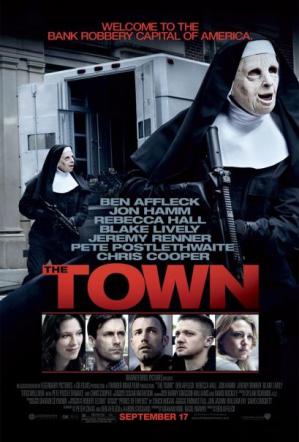
The Town, by Ben Affleck, 2010


I missed out on The Town a couple years ago when it was a big mainstream success and all that.  It's not really the kind of movie I'd typically be interested in, but a combination of crazy good word of mouth and my excitement over seeing Argo finally caused me to cave.  And you know what?  I'm glad I did.  It's a solid and satisfying movie all around, even though we've seen much of it in other movies before.

Ben Affleck stars as Doug MacRay, the leader and mastermind of a ring of Boston bank robbers.  They take the manager, Claire (Rebecca Hall), hostage in the opening heist, and Doug lets her go without hurting her.  He knows that his unstable best buddy Jem (Jeremy Renner) will kill her if she can identify them, so Doug keeps tabs on her, and they strike up a relationship.  Now Doug must keep Claire safe, keep Jem in check, dodge Jon Hamm and the FBI, who are hot on his trail, and plan and execute his next heist under their noses, all while experiencing deep reservations over the life of crime he's chosen for himself.

Affleck really knows what he's doing, if you're wondering.  He had a good script in his hands (which he helped write), surrounded himself with a great supporting cast and crew, and directed the hell out of this thing.  The heists are smartly executed and exciting, the characters are all around interesting and engaging, with layers of conflict between them.  Jeremy Renner steals the show, but everyone is good.  Yes, I would say that Affleck has given his career a second leg that will have much more staying power than his Bruckheimer years.  And good for him. 

 --------------------------------------------------

Well, I kept them both mercifully short today.  I've just been so busy!

Tuesday, September 25, 2012

Explorers

Explorers, by Joe Dante, 1985

How did this movie escape my childhood?  I loved all those 80's adventure movies about kids like me.  The Goonies, Monster Squad, and E.T. were all staples.  Well, I didn't see Monster Squad until a little later, but it became a staple once I did.  Explorers is right along the lines of these movies, and if I'd had it on tape as a kid, it would probably have been just as worn out as my copies of the above movies.

Joe Dante is also one of my favorite directors of that whole period.  I've yet to see a Joe Dante film that I didn't like.  His films always at least attempted to be commercial, yet they tended to skew just a little bit more off-kilter than his peers, such as Zemeckis, Donner, and Spielberg, did, and that quirk appealed to an odd little kid like me.  Dante's films were also brimming with sincere personal touches and his love for the campy B-Movies of his youth.

Explorers may in many ways be up there with Matinee as Dante's most personal film.  It stars two children who look an awful lot like River Phoenix and Ethan Hawke as a couple of kids who are given instructions in their dreams on how to unlock the secrets of interstellar travel.  Along with a third boy, they use this dream technology to clandestinely build their own spaceship and take it to the stars.  There, they, you know, meet aliens and stuff.

Ethan Hawke and River Phoenix are both great in their roles.  Hawke is the normal everyday kid, yearning to escape his life for a while and perhaps explore some uncharted territories.  Phoenix is his nerdy best friend, who is a science prodigy, and able to translate the technology in his dreams into physical reality.  There's a third kid, too, played by Jason Presson.  I actually liked his character a lot, but he wasn't in it nearly as much as his co-stars.  There were even some shots where the three of them were supposed to be sitting next to each other, yet the camera was only on the other two kids.  I wonder if there was some circumstance that prevented him from being in the movie as much as the other two?  Maybe he was difficult, or wasn't available as to shoot as much.

We also get bit parts by Joe Dante regulars, such as Dick Miller and Robert Picardo, who actually has three roles, two of them completely unrecognizable under some crazy alien prosthetics.  And James Cromwell plays River Phoenix's dad.

Explorers is a spirited, adventurous movie for younger children and nostalgic 30-year-olds, and it seems heavily inspired by Dante's own childhood, growing up in the thick of the space race, reading comic books and watching science fiction movies.  Though the film's third act in space is fun, I actually liked the parts of the movie before they leave the earth better.  There are some great sequences involving them building their ship out of old amusement park ride parts, and testing it out in front of a drive-in movie theater.  Even though these scenes had the fantastic elements, I could relate much more to kids scrounging around and using their creative minds to build stuff.  Once they get to space and meet aliens, it's a little out of my wheelhouse,though I'm sure I imagined doing just that a million times.  Which is really what the movie is all about: exploring that vast universe inside yourself.

Thursday, September 20, 2012

Metropolitan, War of the Arrows, Withnail and I

Metropolitan, by Whit Stillman, 1990


Holy cats, guys, I think I've finally found my Whiteness Threshold.  I'm a dedicated Wes Anderson fan, I listen to and enjoy Vampire Weekend, and I say things like "holy cats", so I'm pretty white, but I think Whit Stillman's Metropolitan may have been too white for me.  It's a pretty good movie, I guess, but I just couldn't relate.

Metropolitan follows the lives of a group of rich New York college kids who are a part of the debutante society.  They meet up on weekends and talk about intellectual bullshit (and it's pretty bullshitty, they're college freshmen after all) and basically act like people I could never have a conversation with.  The main character is a kid named Tom, who has hit a financial rough patch with his parents' divorce, and is hanging out with these snobby types even though he's poor.  He's just as pretend smart as the rest of them, though; one of my favorite jokes was when he quotes a criticism on Jane Austen and the girl who likes him, Audrey, asks if he's ever even read the book.  He admits that he hasn't.  In fact, he doesn't read books at all, only criticism.  That way he can get the story and a point of view on it.

Anyway, I'm just giving the movie a hard time.  Objectively speaking, Metropolitan is a good film.  And the characters actually do grow on you as the story progresses, though I still constantly found myself thinking, "do people REALLY talk like this?"  Whit Stillman is kind of gently making fun of kids like this (with a name like Whit Stillman, I assume he was once one of them), and showing that for all their intellectual and cultured talk, they're really just teenagers and they have no real life experience or wisdom to back up their ideas.  I actually would like to see Stillman's film The Last Days of Disco.  Even though I'm sure everybody still talks like this, the subject matter interests me.

War of the Arrows, by Han-Min Kim, 2011

With The Hunger Games and The Avengers and Brave all out this year, bows and arrows sure are popular.  Well, South Korea got the jump on our little trend and made a huge historical epic last year with more arrows than you can shake a bow at.  This movie has more bows and more arrows than all three of those movies COMBINED.  Not only that, but people get shot with said arrows in every imaginable way.  In the arms, in the legs, in the chest, you name it.  Necks.

War of the Arrows isn't all just arrows.  There is also WAR.  And also a brother forming a ragtag group to rescue his kidnapped sister and ward off an invading army.  It's really cool.  The story is engaging, the action is awesome, the characters are likeable.  These are all icing on the cake, though, because what I'm most excited about is the arrows.  The only way this movie could have been better is if the main character had a talking arrow who helped him aim or something. 

Anyway, I know this review is really short and one-note, but I liked War of the Arrows a lot.  Totally worth your time.

Withnail and I, by Bruce Robinson, 1987

Withnail and I is one of the strangest films I've seen in a while, and followers of this blog might know that I watch a lot of strange films.  It's the story of two struggling actors in London in the late 1960's.  Withnail (Richard E. Grant) is a hard livin' type, pretty much a drunk, always raging at the world.  "I" (Paul McGann, AKA the 8th Doctor) is the sort of complacent second fiddle who always goes along with Withnail's schemes and worries himself to death all along the way as they get into deeper and deeper trouble.

There's not really much more of a "story".  It's just a ridiculous, darkly comedic, and weirdly enjoyable chain of events.  They go to get money from Withnail's rich, gay uncle, wind up stealing his car and the keys to his country house.  They end up stranded there with no money.  Then the gay uncle turns up and tries to seduce "I".  And so on.

Withnail and I kind of reminds me of the Coen Brothers' cult classic The Big Lebowski.  Both have lots of non sequiturs, a seemingly-but-not-really random story, and indefinable in terms of genre.  I was also pleasantly surprised to see Ralph Brown, the aging concert promoter guy (or whatever, I haven't seen it in many years) in Wayne's World 2.  He's basically playing the same guy in this, and he's just as hilarious.

I (me, not the character) thought Withnail and I (the character, not me) was really enjoyable, but maybe I didn't get it.  I'm sure it had some deeper meaning in there, there was definitely some commentary on the end of the 60's.  I might have to watch it a second time and see if there's anything I'm not picking up on.  Even if there isn't, it's a pretty great movie.

Friday, September 14, 2012

The Last Wave, Mona Lisa

Well, everyone, I am now once again among the employed. While it feels great, it sadly does mean I may not update as frequently, or watch nearly as many movies. But it also means that soon I will be able to afford to buy Blu Rays again, a luxury I haven't had in some time, and let me tell you, my wish list has been piling up. So keep an eye out, I'll still be around. Just maybe a little less.

The Last Wave
, by Peter Weir, 1977


In 1975, Australian director Peter Weir gained worldwide attention with his eerie, hypnotic, and primal horror film Picnic at Hanging Rock. In 1977, he followed up that success with another horror film, which, though updating its setting to the present, still maintained many of Hanging Rock's core attributes. That film is The Last Wave, and though lesser known than its predecessor, it is no slouch itself.

The Last Wave is the story of David Burton (Richard Chamberlain), a lawyer assigned to defend a group of aborigines accused of murder. Burton, normally a rational man, is drawn to the aboriginals, as he begins having apocalyptic visions involving a recent spate of extreme weather.

The movie is actually kind of hard to describe, but The Last Wave does share some thematic and tonal similarities with Picnic at Hanging Rock. Certainly the sense that nature itself is an overwhelming force, trying to push us away. It seems in these two movies that Australia itself deems people (white people, particularly) unwelcome on its land. Also like Hanging Rock, Weir offers few solid answers for the supernatural phenomena, only implications that the viewers must piece together themselves. That just makes it all the more creepy, of course.

The Last Wave is another fascinating, unique film by Peter Weir. If you've seen any of his films, from Picnic at Hanging Rock, to The Mosquito Coast, The Truman Show, or Master and Commander, you know he has a talent for fascinating, unique films. Check it out!

Mona Lisa, by Neil Jordan, 1986


Bob Hoskins is one of those actors I never realized I was going to miss until he was gone. Not dead, I mean, but recently retired due to Parkinson's Disease. Of course, to me, he was always Eddie, the gruff detective in Who Framed Roger Rabbit?, but he really did have a lot of great roles. His little role in Terry Gilliam's Brazil is a favorite of mine, and I just recently watched The Long Good Friday, which he was awesome in (just watch the subtle changes of emotions on his face in that final shot).

Neil Jordan's film noir, Mona Lisa, is another high point in Hoskins' career. He earned an Oscar nomination for best actor for his performance as George, an ex-con hired as a driver for Simone, a high class call girl (Cathy Tyson). The two eventually befriend each other, and he she asks of him the favor of tracking down a friend of hers, a teenaged heroin addicted prostitute of the street walking variety, who is in too deep. He is also keeping an eye on one of Simone's clients, trying to dig up dirt on him for one of his associates (Michael Caine). George soon finds himself immersed in the seedy underworld of London, and runs afoul of all sorts of bad people.

This is a really cool movie, man. I do not believe I have seen any of Neil Jordan's films before (though I do know the ending of The Crying Game), and I am quite impressed by Mona Lisa. It's dark and grimy, and the characters are interesting, and the performances are great all around. I could have done without the montage of Hoskins checking looking for Simone's friend in all the local peep shows and sex clubs, but that was only because I had to listen to Phil Collins. And hey, it was 1986. If Phil Collins hadn't been playing on that montage, he would have been playing in someone else's really good movie. What I'm saying is, I recommend Mona Lisa, but be warned: Phil Collins.

Tuesday, September 11, 2012

Three Films of the Punk and New Wave Era: Forbidden Zone; Ladies and Gentlemen, the Fabulous Stains; Breaking Glass

Hello! In this entry, I'm going to talk about three rock and roll movies about one of my favorite musical periods: The punk/post-punk/new wave movement of the late 70's and early 80's! And yet I STILL haven't seen Sid and Nancy...

Forbidden Zone,
by Richard Elfman, 1982

Most of us know Danny Elfman nowadays as the guy who scores the Tim Burton movies, but some may fondly remember him as the lead singer of the nutty, theatrical new wave act, Oingo Bongo, or as they were originally called, The Mystic Knights of the Oingo Boingo. Forbidden Zone is the Oingo Boingo movie, directed by Elfman's brother Richard, and intended to give theater audiences a cinematic idea of what an Oingo Boingo show was like.

What's it like? It's like a campy, trashy, John Waters burlesque show on acid. The story is centered on the Hercules family, a family of weirdos who live on top of a portal to the hellish 6th dimension. Herve Villechaize is the king there and he wants to toss aside his current queen and take the Hercules daughter, Frenchie, for his own. The rest of the family one by one go down, either on accident or to rescue her.

Forbidden Zone uses strange costumes, bad makeup, weird sets, and different styles of animation throughout. There are lots of musical numbers, the best of them featuring the songs of Oingo Boingo, though some are using old timey numbers. I'm not sure if I could call it a "good" movie, but it's an extremely culty movie and sometimes that's good. The music is really great. The acting is pretty awful, but also pretty appropriate, since Richard Elfman is obviously aiming for camp value. The cast is mostly just friends and family and Oingo Boingo members. The humor is pretty low brow and often knowingly lame, with the intention to offend everyone (and thus no one).

If you like Oingo Boingo and weird shit, you should probably watch Forbidden Zone. It contains lots of those things. It made me wonder what their early stage shows were like. I bet that would have made for an amazing night.

Ladies and Gentlemen, the Fabulous Stains,
by Lou Adler, 1981

It's funny that punk music had become such a thing by 1981 that they were making Hollywood movies about it. The movement had been declared dead a couple years earlier, and everyone was kind of cashing in their chips at this point. Ladies and Gentlemen, the Fabulous Stains is one such movie, though it has an air of authenticity lent to it by some real deal punk legends.

A young Diane Lane stars as Corinne Burns, a cynical teenager whose mother's recent death has spun her into one of those "nothing really matters" phases. After causing a mild stir by being fired from her fast food job while on a televised news report, Corinne announces to the world that she's the singer of The Stains, a band she has with her sister (Marin Kanter) and cousin (Laura Dern).

This is spun into a gig as an opening act for an over-the-hill metal band and an up and coming punk band called The Looters. The only problem is, nobody checked to see if The Stains can play. They're terrible. The sister and cousin can't play their instruments and Corinne can't sing. When booed off the stage, Corinne makes up for her lack of musical ability with her true talent: telling people why they suck and why she's awesome. She is perceived as a new feminist icon and spins The Stains into stardom with a plagiarized song, until, of course, it all comes crashing down.

I liked Ladies and Gentlemen, the Fabulous Stains a lot. It's directed by Lou Adler, best known for The Rocky Horror Picture Show and Cheech and Chong's Up In Smoke, both cult movies in their own right. But I think this is a better film than those two. It's not a "punk" movie, but it's cynical, darkly funny, and self aware enough to even mock itself a little. I thought Diane Lane gave a great performance as a teenage girl with a lot of rage and no real outlet for it. And a young Ray Winstone plays the singer of The Looters, who are rounded out by members of The Clash and The Sex Pistols. The Stains' main (plagiarized) song, Join the Professionals, was written by the former Pistols guys and it's a real-deal, legitimate sounding punk song.

Ladies and Gentlemen, the Fabulous Stains is good stuff. Unlike Forbidden Zone, you don't have to be a weirdo like me to like it. It's a well made satire with some cool music that never really found the audience it deserved.

Breaking Glass, by Brian Gibson, 1980

It's funny: Breaking Glass is sort of the sincere version of the story that Ladies and Gentlemen, the Fabulous Stains was being sarcastic about. Well, I'm not sure if "sincere" is the right word. This movie has the stink of the English Pop Star Making Machine all over it.

It stars an up-and-coming New Waver named Hazel O'Connor, as Kate, an up-and-coming New Waver. The movie follows the course of her career from idealistic young punk who refuses to sign a record contract, through the formation of her band and first hit, the temptation of success and alienation of said band, and ultimately, the unhappy ending of her being a superstar with no integrity. Apparently there's another scene at the end but it was cut out of the US version for no good reason.

The thing is, Hazel O'Connor hadn't even released an album at the time of this movie's release. Her first was the soundtrack. There was probably a conversation at some executive office like:

"If we make a pop star and give her a movie telling everybody she's a pop star, she'll be HUGE!"

"Yeah, but won't people see right through that?"

"No, see, we'll make it a cautionary tale, and show her unhappy with her success, as if to say, the REAL Hazel O'Connor would never do that."

"I don't get it but you sign checks!"

Anyway, I don't mean to dis Hazel O'Connor, just whoever was pulling the strings. She wasn't just a one-hit wonder, and she still releases music to this day. The songs in the movie are actually pretty good, and they're produced by Tony Visconti. The production sounds a lot like David Bowie's Low/"Heroes"/Lodger period that Visconti was working on at the time of this movie. It's even safe to assume that the band in the movie (and the movie's title), Breaking Glass is named after the Bowie song on Low.

Breaking Glass isn't great, but it has some cool songs, and it also has Jonathan Pryce playing a deaf saxophonist with a heroin addiction, so it can't be all bad, right?

Friday, September 7, 2012

Shadows and Fog and Walker: Two Comedies About Sticking Our Noses Where They Don't Belong

Shadows and Fog, by Woody Allen, 1991


I've seen most of Woody Allen's films at this point, although I've fallen off in recent years. I was pretty sure I had seen most, if not all, of the best ones, which left me pleasantly surprised at how much I enjoyed his 1991 film, Shadows and Fog.

A darkly comedic homage to German Expressionism, Shadows and Fog has some really beautiful black and white cinematography. In fact, there are tons of shadows and lots of fog in the movie, as I suppose should be expected. Set, I think, in the 1920's, a serial killer is stalking the streets and strangling his victims. Kleinman, a nebbishy 50-ish Woody Allen type, played by Woody Allen, is awakened in the middle of the night by the men of the neighborhood, who are forming a vigilante group to hunt this guy down. He is peer pressured into joining, despite his well-founded reservations.

At the same time, at a travelling circus outside of town, a couple, a sword swallower (Mia Farrow) and a clown (John Malkovich) to be exact, get in a fight over cheating and having kids, and the sword swallower, Irmy, leaves the clown. In the city, she falls in with a prostitute (Lily Tomlin), who takes her into her whorehouse for safety, and the two main stories begin to collide.

I really liked Shadows and Fog. The story is complex, funny, spooky, and interesting, Allen's directing is at its best, and the cast is top notch. It includes Allen, Farrow, Malkovitch, Tomlin, Madonna, Kathy Bates, Jodie Foster, Donald Pleasance, John Cusack, and even a brief appearance by William H. Macy. I especially enjoyed Pleasance's small part as a coroner, and Cusack as a young student infatuated with Farrow, who he believes to be a prostitute. The payoff at the end is pretty great too.

Woody Allen has made a lot of movies. I'm not sure where Shadows and Fog would rank among them, but I'd put it somewhere in the top half, and that's saying quite a lot.

Walker, by Alex Cox, 1987


I didn't know what to expect when I turned on Alex Cox's trippy anti-Biopic, Walker. Cox, director of Repo Man and Sid & Nancy (which I still haven't seen!), brought his punk-rock ethos to the Historical Biography genre, and destroyed his own Hollywood career in the process. Walker is a truly strange mess of a movie, and I kind of loved it.

Walker is the story of William Walker (Ed Harris), an American soldier of fortune in the 1850's who leads a group of mercenaries into Nicaragua to liberate the locals, only to take over and become dictator himself. Cox is not so much interested in historical facts, however, and he plays fast and loose with the truth. He's more interested in commenting on what America was actually doing in Latin America in the 1980's, and he viciously comments on it throughout.

There's lots of hilarious black comedy in Walker, such as the battalion drummer who asks to sit out on the next day's battle because he's noticed in all the war paintings that the drummer is always one of the corpses. Walker looks him in the eye like a holy man and says "as long as I am your commander, no harm shall come to you." Of course, at the battle he is gunned down violently and repeatedly, as Walker is somehow able to walk through all the carnage magically unscathed.

In addition to the comedy and the carnage, there is a surrealist element to Cox's film as well. As the movie progresses, he starts sneaking in historical anachronisms, to remind us that this isn't the 1850's he's talking about, this is today (1987). At first it's something like someone lighting a fuse with a Zippo lighter, or a guy drinking a bottle of Coke, but by the end, there are helicopters disrupting the period authenticity.

Add to all this an excellent, moody musical score by Joe Strummer of The Clash, and you have in Walker a great piece of anti-establishment cinema; shocking, funny, violent, and rebellious. I think it was slammed by critics at the time of its release, but like the best cult movies, has later experienced some rehabilitation and found an audience. Some even hold it up as Alex Cox's best film. I still need to watch Sid and Nancy, so I don't know yet. I sure dug it, though.

Tuesday, September 4, 2012

The Hurt Locker, The Long Good Friday, Scarface (1932), The Last Laugh

The Hurt Locker, by Katheryn Bigelow, 2008

It took a long time before I got around to seeing The Hurt Locker. I really should have seen it in the theaters, but for some stupid reason, I didn't. Well, I saw it, and like everyone said, it's pretty awesome. It might go down as one of the few times the right movie won the Best Picture Oscar.

Jeremy Renner stars as a leader of a military bomb squad in the Iraq war. He's cocky, has a reckless attitude, and seemingly a death wish. The movie doesn't necessarily have a plot, so much as an episodic series of bombs, each situation elevating in intensity from the last, as the men count down the days, wondering if they'll survive to the end of their tour of duty under this guy.

The performances are all around great, especially Renner. I can see why Marvel wanted him as Hawkeye now, though he had little opportunity to show these traits in The Avengers. Director Kathryn Bigelow, who has been around and doing solid work for some time now, steps up her game big time. The movie is well shot and edited and loaded with tension of both kinds: between the characters and in diffusing the bombs. I really have nothing negative to say about The Hurt Locker. Great movie.

The Long Good Friday, by John Mackenzie, 1980

You know, I couldn't get into The Long Good Friday at first, but it became more and more engaging for me as it went on, all the way to the end. The last ten minutes or so are excellent. It might just have been the time of night that I watched it, which I think was pretty late, or maybe I just wasn't paying enough attention at the start. Either way, I know it's a well regarded film, and I liked it enough.

The Long Good Friday is the movie that really put Bob Hoskins on the map. He plays gangster, trying to become a legitimate businessman (with funding from the mafia, whaaaaaaat?). When his men start getting picked off by someone, he goes on a violent manhunt trying to find the culprit. Hoskins' character is pretty nuts, leaving a trail of bodies wherever he goes, and by the end, even the mafia has second thoughts about associating themselves with this guy.

It's pretty good, probably actually better than I'm giving it credit for. Really strong performance by Hoskins. I was sad to hear about his recent retirement due to Parkinson's. The guy was great in a ton of stuff.

Scarface, by Howard Hawks and Richard Rosson, 1932

Forget the Al Pacino/Brian De Palma remake, this is the classic Scarface. Based loosely on Al Capone, this Howard Hughes production is probably about as over the top and violent as a film in 1932 could possibly get.

Scarface is Tony Camonte, played by Paul Muni, an ambitious gangster, second in command to Johnny Lovo, who runs the south side of Chicago. Camonte begins to eye both the Irish-run northside of the city, as well as the leadership position held by Lovo. He even makes moves at stealing away Lovo's girl. Eventually, Camonte's ambitions get the best of him, and, you know, a hail of bullets.

Scarface is pretty excessive, even for a Pre-Code movie. I read that Howard Hughes just had Howard Hawks make the movie how he wanted it, and they would worry about getting it through the system later. That was pretty ballsy at the time. As a result, we got one of the first truly great gangster films, and still one of the best ever.

The Last Laugh, by F.W. Murnau, 1924

F.W. Murnau, best known as the director of spooky silent masterpieces Nosferatu and Faust, brings us a smaller and more personal, but no less interesting film. The Last Laugh is the story of an old man (played by future Nazi Emil Jannings), content in his job as a hotel doorman. His increasing age and infirmity are making it harder to do his job, and his boss reassigns him to the undignified job of a bathroom attendant. The old man falls into a depression, his life has lost all its meaning, and becomes a laughing stock to all his friends and family.

That's pretty depressing, right? What a horrible statement on life to have to hear, huh? Well here is why the movie is great: After all that heavy stuff, the audience is given a reprieve. A title card comes up and says something along the lines of "This is where the story should end, but we took pity on this guy and decided to give him a break". The final act of the movie is an improbably joyful payoff, where the doorman randomly inherits a bunch of money and lives like a king, while those who treated him poorly are punished.

The film flat out tells us that this isn't how real life works, that this is just a fantasy, but despite that knowledge, we still take joy in his happiness, and leave the movie feeling a little better about things. The Last Laugh is, ultimately, a movie about the very purpose of going to the movies. They're a brief escape from the harsh reality of life.

Tuesday, August 28, 2012

Electric Dreams and Just Imagine: Two Quaint Science Fiction Comedies

In this entry, I'm going to look at two futuristic comedies made more amusing by the fact that they were so of their time. Sadly, neither of these movies are commonly available, but both can be found if you know where to look.

Electric Dreams
, by Steve Barron, 1984

In the 1980's, the dawning age of home computers was all the rage. There are tons of classic movies from the era looking at this new technology, from Tron, to War Games, to Weird Science. For some reason, as time made classics of these films, Steve Barron's Electric Dreams fell by the wayside.

Electric Dreams follows Miles (Lenny Von Dohlen), a man who purchases a home computer to help him with his work as an architect. He gets way into his computer and buys all sorts of nonsensical add-ons, giving his computer control of all the appliances in his house. When he spills a bottle of champagne on the keyboard, the computer (of course) gains sentience (and amorousness). The computer, named Edgar, is voiced by Bud Cort. Things heat up when they both fall for the cute cellist next door (a young Virginia Madsen), and a jealous Edgar tries to woo her away by composing electronic songs for her and sabotaging Miles' life.

It's a very cheesy and VERY 80's movie, but I have a soft spot for stuff like this. There are a lot of clever scenes in it, and though it's not a great movie, it certainly has its moments. It has very good music, too. The score is by synthesizer wizard Giorgio Moroder, best known (by me, anyway) for producing a new wave version of Fritz Lang's masterpiece Metropolis, and the soundtrack features songs by Jeff Lynne and Culture Club, among others.

Now I know I said Electric Dreams is not a great movie, but I would argue that in it's way, it's kind of an important movie. You see, director Steve Barron, who permanently has a place in my heart for directing the first Teenage Mutant Ninja Turtles movie, will probably be best remembered for directing some of the most important and groundbreaking music videos of the early MTV era. Michael Jackson's Billie Jean? That's his. A-ha's Take On Me? His too. Dire Straits' Money for Nothing, Thomas Dolby's She Blinded Me With Science... If you're a child of the 80's, you get the picture.

When Electric Dreams came out, it drew criticism for having a flashy, MTV-style look. The editing feels just like an 80's music video. Videos didn't yet have the respect and acceptance as an art form that they came to earn (due in no small part to Barron's work). Flash forward a decade and many of the most acclaimed movie directors were coming out of MTV, from David Fincher to Spike Jonze to Michel Gondry. Now Barron's editing technique is completely accepted and even internalized in the industry. Electric Dreams, though firmly dated by its tone and content as a movie from 1984, is, in a way, years ahead of its time.

Just Imagine, by David Butler, 1930

I'm genuinely surprised that Just Imagine is not officially available on DVD, or even to stream. It's a true curiosity of its time, one of only a few science fiction features to be released in the 1930's, and a musical, to boot.

Just Imagine takes a look at earth in the distant future of 1980(!), where people are named with numbers (this was five years before Social Security), the government chooses who a woman must marry (they're working on that now), and couples order their babies from vending machines (why not just have sex?). Fear not, some things are still the same. The cops are still Irish stereotypes.

Our hero is J-21 (John Garrick), a man who wishes to marry his sweetheart, LN-18 (Maureen O'Sullivan), but must find a way to distinguish himself before the judge chooses her other suitor, MT-3 (Kenneth Thomson), a rich, mean jerk. J-21's best friend, RT-42 tries to cheer him up by taking him to watch some scientists revive a man who had died in 1930, who they take under their wing. He takes the name Single 0, and is played by El Brendel, a vaudevillian whose schtick was playing a bumbling Swedish immigrant, which seems weird and totally random but probably made more sense in 1930, because he made a ton of movies. Together, in hopes that J-21 will gain the fame necessary to win LN-18, they make the first flight to Mars, where an adventure awaits them.

The futuristic world is gloriously ridiculous, with wonderful, top notch production design, but as this was a year into the Great Depression, most of the jokes are gentle pokes at the world of 1930. When Single 0 asks if Prohibition is still on, they tell him that the government is talking about legalizing wines and beers. His response: "They're still saying that?"

The musical numbers are a little lacking. None of the songs are about the future! They're all about the 1930's, or things the audience could relate to, I guess. They could have been a whole lot more clever. There's one song, no kidding, about how J-21 wants an old fashioned girl like his grandmother. While he sings this they cut to shots of LN-18 as a modern 1930's woman doing 1930's things. You know, like smoking cigarettes. There is one really cool musical number toward the end, with a bunch of sexy martian women dancing in worship of the huge martian god statue.

Just Imagine is certainly no Metropolis, but it's one of the few cinematic attempts to look into the future we have from that time. Though most of the movie consists of cute observations and sentimentality, beggars can't be choosers.

Monday, August 27, 2012

Mommie Dearest and The Swimmer: Two Bizarre Films by Frank Perry

Mommie Dearest, by Frank Perry, 1981
Mommie Dearest probably needs no introduction. It's a true camp classic, with one of the greatest over-the-top performances in movie history: Faye Dunaway as unhinged screen legend Joan Crawford is a sight to behold. It's the "true"? story of Christina Crawford, Joan's adopted daughter, who suffered a lifetime of verbal and psychological abuse by her crazy movie star mother. I'm sure there is actually a good deal of truth to the story, but the movie and its star are just so excessive that I can't imagine it played out like this in real life.

Even if you haven't seen Mommie Dearest before, scenes and lines have become part of pop culture. I'm sure we all know the "No More Wire Hangers" line, right? I feel kind of bad for Faye Dunaway, for being so ashamed of this role. It's a tour de force, whether she acknowledges it or not. She really transforms herself into Joan Crawford, and when Crawford goes crazy, Dunaway is hilariously and delightfully watchable. I know that's probably not what she intended to be, but we've seen Network, Chinatown, and Bonnie and Clyde, so we know Faye Dunaway can act. And act she does. And act and act and act. Nobody told her she was acting in a comedy.

Mommie Dearest is a rare instance of a studio putting a new spin on their marketing of a movie. When audiences at screenings laughed throughout, Paramount decided to sell it as high camp, and made a tidy profit on it. We all know that Dunaway wasn't happy. I wonder what director Frank Perry thought of it. I kind of get the sense that that was what he was going for all along, but who knows? There's a scene toward the end when 20-something Christina falls ill and her 60-year-old mother fills in for her on the soap opera she was acting on while she recovers. That's hilarious! And I felt like Frank Perry was aware of the humor of it all.

Regardless of whether it was meant to be funny or not, Mommie Dearest is one of the most insane movies ever made. Utterly tasteless, but undeniably watchable. Its cult status is well earned.

The Swimmer, by Frank Perry, 1968
After seeing Mommie Dearest, I was curious about the work of Frank Perry, so I sought out his 1968 film, The Swimmer, adapted from a John Cheever short story. It's a surreal, allegorical tale about Ned (Burt Lancaster), a successful man who decides to swim home through all the swimming pools across the county. On his journey through his neighbors' backyards, Ned encounters many people from his past, and has discussions with them, where more and more about his own nature is revealed, before swimming through their pools and running to the next yard. As the movie progresses, we realize, along with Ned, that he isn't the happy, successful, pleasant man he at first seemed to be.

The Swimmer is very much a piece of late sixties weirdness. It hasn't endured or held up the same way a lot of the major movies from that time period have. It kind of shares some themes with The Graduate. Not only the whole swimming pool thing, but also the notion that our ideas of success and The American Dream have become rather hollow, an idea very much prevalent in the 1960's.

I found The Swimmer to be an interesting film, but not a great one. This may come as a surprise, but this movie by the director of Mommie Dearest is NOT the most subtle of allegories. Everything is really on-the-nose, and you feel like he is driving the point home by repeatedly punching your face with it. As the narrative progresses, Ned, having been swimming, running half naked through the woods, and realizing what a piece of shit he is all day, starts getting colder and colder. By the end of it, he's basically holding out his fists and yelling "NOOOOOOOOOOO!", like Darth Vader at the end of Revenge of the Sith.

Still, The Swimmer is at least an interesting artifact of its time, and worth noting for that. They don't make movies like it now, and there was really only a brief period where they did.

Friday, August 24, 2012

Hyper-Violent Sci-Fi Satires by Guys Named Paul Double Feature! Death Race 2000 and Robocop

Death Race 2000, by Paul Bartel, 1975

I love the way Roger Corman worked. He would give his writers and directors near total freedom to make the movie they wanted within the parameters he assigned them. He might give them a title and a star they had to use, and they had to include a certain amount of violence and nudity (these were exploitation movies, after all), but the rest of the decisions were up to them. Sure, he brought a lot of garbage into the world. Some of that garbage is totally watchable, but a lot of it isn't. And every once in a while, he would give us a true gem. Paul Bartel's action packed satire Death Race 2000 is one such gem.

In a future totalitarian state (in the year 2000, naturally), the government holds a violent race, as a means to keep the masses in check. The object of the race is to drive across the country in souped up cars, earning points along the way by running over civilians (extra points for children!). The champion and star of the Death Race is Frankenstein (David Carradine), a mysterious masked driver who finds himself in the middle of an underground resistance's attempts to assassinate the dictator, AKA Mr. President.

Death Race 2000 is over-the-top, ridiculous, full of gratuitous violence and nudity, and very, very funny. Carradine is great as Frankenstein, and a pre-Rocky Sylvester Stallone also stars as his rival, Machine Gun Joe Viterbo. Paul Bartel at his best (this and Eating Raoul in particular) was a sharp and witty satirist, and with Death Race 2000, he's giving the moviegoing audience exactly what they need to satisfy their bloodlust, just like the spectators of the Death Race itself. At the same time, he's maybe getting some of his more observant audience members to question that bloodlust. So maybe that violence and nudity isn't all gratuitous after all. OK, it's still pretty gratuitous.

There's also a bit of a subtle feminist message in there, just by having male and female racers on equal ground and no attention being drawn to that fact. Sure there's also plenty of nudity that might negate that message, but as I said before, including the nudity was part of the deal, and Bartel did try to throw in some male nudity to balance things out a little.

Death Race 2000 is a whole lot of fun, and with some great social commentary that was maybe even a bit ahead of its time. I was thinking a great double feature might be to partner this with Albert Brooks' hilarious 1979 mockumentary, Real Life, which basically predicts reality TV a good two decades before it blew up. OR, if you want to keep the violence coming, you could partner it with...

Robocop, by Paul Verhoeven, 1987

Yes, this is the perfect double feature partner for Death Race 2000. Another hyper-violent science fiction super-satire, Paul Verhoeven's 1987 classic Robocop gives us a near future run by corporate interests and crime lords. It's scarily prescient and in some ways may be even more relevant today than it was in 1987.

In a run-down future Detroit, a huge corporation called Omni Consumer Products has its eyes on replacing the police force with its own robotic force. When a prototype for a giant crimestopping machine called ED-209 malfunctions, another plan goes into place, one to convert a cop, recently murdered in the line of duty, into a cybernetic killing machine. That cop is Murphy (Peter Weller), a good man, with a wife and a son. Murphy must then overcome the programming his corporate overlords imbued in him, and rediscover his own humanity in order to bring peace to the streets of Detroit.

I had seen parts of Robocop here and there, but this was my first time watching the movie from beginning to end. The violence is excessive to the point of being downright comedic, and if Verhoeven's intent with that wasn't evident, the hilarious interstitial news reports and commercials woven into the narrative should make it clear. He's using the violence to make a point.

Something that really stood out about Robocop for me was the fact that, besides all the extremely horrific content, it still feels like a kids movie. Robocop's even got a little kid he wants to impress with his gun twirling skills. It's hilarious to think that in the 80's this actually would have been marketed towards kids. There were surely action figures and everything. I remember Robocop toys when I was young, but I don't remember if they were for this or the sequels.

Anyway, Robocop is great. Peter Weller is great, too, though I will always prefer Buckaroo Banzai over this role. I love the stop motion animation of the ED-209 and the animatronics and all the other effects, too. I don't know what took me so long to watch this movie. Both of these movies, really. Watch em watch em watch em!

Tuesday, August 21, 2012

Cul-de-sac, Reds, What Ever Happened to Baby Jane?

Since these multiple review columns that I was originally doing to play catch up have become the norm, I've decided to drop the dumb "Grab Bag" title. I'm sure everyone will miss it.

Cul-de-sac
, by Roman Polanski, 1966

I haven't seen many of the old Roman Polanski films, but I hold Chinatown in very high regard (as one should), so I thought I'd take a look at something else. Cul-de-sac is Polanski's third film, a home invasion thriller-comedy of sorts, about a married couple who live in a castle on an island taken hostage by a fugitive criminal stranded there by the high tides. Donald Pleasance stars as the timid, emasculated husband.

I don't know, there was some interesting stuff in the film, but I have to say, I didn't really care for it. I had a hard time liking, or even sympathizing with any of the characters. Donald Pleasance built a career out of playing pushovers and weak men like this, but I've liked him more in other movies. I did like the setup of the criminal's car breaking down in the middle of a rising tide, forcing him to abandon his accomplice, dying of a gunshot wound, but the story gets more and more improbable and labored as it continues. It gets to the point where company comes to visit and the criminal pretends to be their butler. If it were just a wacky comedy, that might work, but the movie presents it semi-seriously, and it didn't work for me.

I'm not giving up on Polanski just yet. There are still a couple of big ones I should look into. I haven't even seen Rosemary's Baby! But Cul-de-sac just didn't cut it for me.

Reds, by Warren Beatty, 1981

Now this, I liked. Reds is Warren Beatty's epic, about Jack Reed, an American communist journalist and writer who helped out with the Russian Revolution in the 1920's. The narrative is tied together through interviews with the actual surviving colleagues and contemporaries of Reed, at that point in their 80's and 90's. Beatty was always a smart and capable director and producer, and had a hand in the development of many of his most memorable starring roles, often nurturing them for years before they got made. Reds may be his crowning achievement.

With a cast including Beatty, Diane Keaton, Jack Nicholson, and Gene Hackman, Reds feels like the dying breath of the stellar auteur-driven Hollywood of the 1970's, which had collapsed under the weight of bloated disasters such as Cimino's Heaven's Gate (which I haven't seen) and Altman's Popeye (which I love, warts and all), and the massive success of mainstream blockbusters like Star Wars and Jaws.Link
I love that Reds was about a group of American communists, which was very much a serious movement in the America of the early 20th Century, though it wasn't something anybody wanted to talk about after the 1950's. That this movie came out in the Reagan administration is a wonder unto itself.

The 3 hr 15 min run time is a bit of an obstacle, but I was never bored. The movie spans years, and is filled with action, drama, romance, and tragedy, like all good epics. It won Oscars for directing, cinematography, and supporting actress (Maureen Stapleton), and was nominated for many more, yet Reds isn't discussed much today, is it? It's strange how so many of the 1980's Oscar winners have been overshadowed by all the sci-fi/fantasy movies and comedies of the era that we grew up watching. Anyway, Reds is worth setting aside a sizeable chunk of your time for.

What Ever Happened to Baby Jane? by Robert Aldritch, 1962

I am so glad I have finally seen this crazy movie. An aging Bette Davis runs rampant as Baby Jane Hudson, an over-the-hill child star, driven mad by her jealousy over her sister Blanche (Joan Crawford), a beloved screen actress, now wheelchair-ridden from a car "accident" and held captive in her bedroom.

Director Robert Aldritch and screenwriter Lukas Heller give the film a noirish, stylized look and a macabre sense of humor, while Davis and Crawford act their hearts out. I should also mention Victor Buono's hilarious performance as Edwin, a piano player hired by Jane to help revive her "career".

Whatever Happened to Baby Jane? is a true classic movie that has all the markings of a cult classic. The movie is so dark, twisted, weird, and disturbing, by 1962 standards, that I'm surprised it ever made it into theaters, let alone to so much acclaim and success. Things were just starting to loosen up around then, so I guess Baby Jane made it through, and I'm glad that it did.

--------------------------------------------------

So that's all for now. I'm very slowly catching up. It's my hope to be close to current by October, but I'm like 30 movies behind right now and I've been watching movies every day. Of the above three, I would most recommend Whatever Happened to Baby Jane?, though Reds is great too. You can skip Cul-de-sac and watch Chinatown again instead.

Thanks, everyone!

Sunday, August 12, 2012

Mad Max: Beyond Thunderdome


I'm a huge fan of Mad Max and it's even-better sequel, The Road Warrior. I don't like making lists, but if I did, I just might rank The Road Warrior in my top 10. I was a little worried about the third installment, 1985's Mad Max: Beyond Thunderdome, since you just don't hear people say too many good things about it. I was pleasantly surprised. While I think it's the worst of the series, there's a lot of really cool stuff in it anyway, and it's still worth watching if you love Mad Max like I do.

The first act of the movie follows Max Rockatansky as he finds himself in the middle of a (literal) power struggle between Auntie Entity, the leader of Bartertown, a last ditch effort to keep some semblance of civilization in the wake of the apocalypse, and Master-Blaster, the megalomaniacal dwarf-and-giant combo who control Bartertown's electrical supply. These are the movie's best sequences.

It takes a turn for the worse as Max finds himself as a savior to a bunch of child survivors of an age-old plane crash. The kids are sort of smack in the middle between the Ewoks and the Lost Boys from Hook, and just as annoying as both. It's as if the studio said to George Miller, "Hey, people really liked the Feral Kid in Road Warrior. Do more of that."

The third act picks up a bit as it finally delivers the car chase action that Mad Max movies should deliver up front. I think that was my biggest concern with the movie for the first two thirds. Where the hell are those crazy souped-up cars? Well, you just have to wait.

It's really the inclusion of annoying kids that bugs me. And the toned down violence, but I can get past that, I guess. If they all had razor boomerangs that cut the bad guys' fingers off, maybe they'd be fine.

There's a lot to like, too. Mel Gibson is great. Bruce Spence returns as a pilot, though it's unclear if he's actually the Gyro Captain from Road Warrior. It's safe to say he probably is. Like he did with Road Warrior, George Miller shoots Thunderdome to look like a radiation-burned Akira Kurosawa movie. Max is a post-apocalyptic Yojimbo. I love how vivid and detailed the Mad Max universe is at this point. Miller has deepened and expanded it with each movie, and the amount of detail in the production design is insanely impressive. This place looks funky and lived-in. And hey, how many movies can boast Tina Turner in a weird wig? Or a dwarf who rides on a giant's back who consider themselves one unit?

Mad Max: Beyond Thunderdome is an imaginative, watchable sequel, but it seldom reaches the heights of its predecessors. For a great down and dirty, low budget exploitation film, watch the first Mad Max. For a bigger, better, more intense, downright crazy action movie, watch The Road Warrior. Thunderdome is like the family friendly, 80's Steven Spielberg version of those movies.

Friday, July 13, 2012

Grab Bag Smoochies Edition: The Pajama Game, A Farewell to Arms, As Tears Go By

Got three more reviews. These movies all have romances at their center, so I guess that's kind of a theme.

The Pajama Game
, by Stanley Donen and George Abbott, 1957
Ok, I admit I wasn't prepared for The Pajama Game. I knew little about it when I pressed play. I just saw that Stanley Donen directed it, and hey, I love Bedazzled. And I saw that Doris Day was in it, and with that title, I assumed it was going to be like Pillow Talk or something (which I've never seen either but have an idea in my head of what it's like). Well, instead, it was a musical about... unions.

The Pajama Game is about a guy (John Raitt) brought in to oversee a pajama factory who falls for the girl (Doris Day) who represents the workers in the union. She's fighting for a 7 1/2 cent raise and he's just trying to prevent a labor dispute, and their relationship gets in the middle of it.

I'm not one of those guys that goes "UGH, musicals". In fact, I quite like them. This one had some pretty good numbers in it, with catchy songs, though I thought some of them went on for way too long and did little to advance the story. Overall, I don't think The Pajama Game was really my thing, but I could see how the Broadway show of it might have been pretty fun.

I'm glad I watched it, though, because of all the decades of American cinema, the one I'm least knowledgeable of is definitely the 1950's, and this was a film from that period that I wouldn't have normally thought to watch. So it was worth it.

A Farewell to Arms, by Frank Borzage, 1932
A classic, Best Picture nominated adaptation of Ernest Hemingway's story, A Farewell to Arms is a tragic love story between an American ambulance driver and an English nurse set in the backdrop of the first World War. I've never read any Hemingway, so I can't judge it based on any knowledge of him, though I did read on the Wikipedia entry that the film is less pessimistic.

I enjoyed A Farewell to Arms a great deal. Helen Hayes and Gary Cooper were both very good in the leads. I totally bought into the love story. But the best part of the movie for me was the beautiful and dense black & white cinematography, for which it won an Oscar. I would recommend the movie for that alone.

As Tears Go By, by Wong Kar-Wai, 1988
I've been reluctant to watch more of Wong Kar-Wai's films for quite some time. I saw Chungking Express many years ago and loved it, and then I watched Ashes of Time and didn't care for it at all. I know he's one of the most acclaimed and respected directors out there, but I was unsure where I stood with him, after that.

His debut film, As Tears Go By, falls somewhere in the middle of those two for me. It's one of his most successful films over in Hong Kong, but I don't think it wears it's age very well. It screams 1988 in just about every way imaginable, all the way down to a Chinese cover of 80's cheese ballad "You Take My Breath Away". The cover of The Cranberries' "Dreams" in Chungking was much much better, in my opinion.

As Tears Go By is the story of Wah (Andy Lau), a mob enforcer, who is good at his job, which from what I gather is collecting money from other mob guys and beating the shit out of those that don't have it. He keeps himself out of trouble by following the chain of command and laying low. His brother, Fly (Jackie Cheung), on the other hand, is all talk and no game. His belligerent attitude gets him in trouble time and again, and it's up to Wah to keep him in line and protect him from those who hate him (EVERYONE). You already know from that set up that things aren't going to end well for these two, right?

Meanwhile, Wah is tasked with letting Ngor, a distant cousin (Maggie Cheung), stay at his place while she is visiting Hong Kong for medical reasons. They connect with each other and soon fall in love, even though she knows the world he lives in. I never felt that creeped out by the cousin thing, because it was pretty well established that she's not that closely related (Wah never even knew she existed), and found myself rooting for them to work out.

The movie is decent. Wong Kar-Wai's talent is on full display, though not as honed as it comes to be, and with a pretty low budget. His films always have such sharp and vivid colors. There are a lot of reds and blues in this, and his reds are very red and his blues are very blue. It got a ton of award nominations in Hong Kong, and won for art direction, which is unsurprising.

I found the little brother character pretty hard to bear, but I think that was sort of the point. He won the Hong Kong best supporting actor award for it. He was super insecure from having Andy Lau as a big brother, and wouldn't we all be? There's a part where Andy Lau shoves a gun down the front of a guy's pants and pulls the trigger. He doesn't hit anything, but he makes it clear that he could have. How can you live up to that?

-----------------------------------------------------

Boy, I didn't expect that last one to be so long. That was practically a full review itself, wasn't it? These mini reviews were supposed to save me some time! Oh well, I had fun writing it. Hope you enjoyed. I've got a lot more movies to talk about, including some new releases here and there, and even one that is only playing festivals here in America.

Thanks for reading!

Monday, July 9, 2012

Grab Bag: Peeping Tom, Hopscotch, Where the Sidewalk Ends

Three more movie reviews coming your way. No theme today, just some good old movies that I think are all worth your time. Enjoy!

Peeping Tom by Michael Powell, 1960

Mere months before Alfred Hitchcock's Psycho was released here in the states, a somewhat similar film was released in England, to much less acclaim: Michael Powell's Peeping Tom. The story of a cameraman who kills women in order to preserve the look in their eyes at the moment of their death, Peeping Tom is a bit edgier than Psycho, focusing less on the Hollywood thrills and twists and turns that Hitchcock preferred and instead takes a more subdued, realistic, and well, British approach.

I actually may have liked Peeping Tom better than Psycho, if that's possible. Mark Lewis, the killer character played by Carl Boehm, is a more realistic portrayal of the psychology of a serial killer than Anthony Perkins as Norman Bates. He is less charming than Perkins, and is more of the quiet, strange man who lives upstairs. As a child, his psychologist father filmed him at every moment of the day, often intentionally scaring him to record his reaction. There's a very unsettling sexual subtext to the footage and Mark's reaction while watching it. There's a lot of sexual subtext throughout.

Upon release, Peeping Tom tanked, but over the years, the critical reception for it has completely turned around. Now regarded by many as a masterpiece, it was a bit ahead of its time, I think, and people didn't know what to make of it. Anyhow, this movie is a must. Check it out, if you haven't. It would make a perfect double feature with Psycho.

Hopscotch by Ronald Neame, 1980
Whew, look at that poster. That is not a movie I would want to see. Perhaps not the ideal marketing campaign for Hopscotch, but then again, what do I know?

Hopscotch is the story of Miles Kendig (Walter Matthau), an experienced CIA field agent who is punished for no good reason by his superior, and put on a desk job. To get back at them, Kendig runs off, goes into hiding, writes a tell-all book exposing all of his dirty laundry, as well as the CIA's and the KGB's, and threatens to publish.

The movie is a smart, funny, and spirited chase movie, as Kendig leads his CIA superior (Ned Beatty) and replacement (Sam Waterston) on just to mess with them. It's unpredictable, since Kendig keeps his plan under wraps, even to the audience. I like the low tech, analog aspect. Spy movies with crazy technology are cool, but there's something really fun about it all being done the old fashioned way. It's sort of like Tinker Tailor Soldier Spy in that way, but, you know, funny. Walter Matthau is great here as always.

Where the Sidewalk Ends, by Otto Preminger, 1950

This has nothing to do with the Shel Silverstein book. It's a film noir, and a good one, at that.

Where the Sidewalk Ends is about Mark Dixon (Dana Andrews), a hotheaded detective, recently demoted for his violent impulses. When investigating a murder at an underground gambling house, Dixon is sent to question a possible but unlikely suspect, one that he shouldn't have much problem with. Well, Dixon ends up accidentally killing the guy.

He attempts to cover it up, but things only get worse from there, as he takes a liking to his victim's estranged wife and father-in-law, a cab driver prone to exaggerating stories. How far can Dixon carry his guilt? When will the lies pile up too high?

Where the Sidewalk Ends is a satisfying film noir, though in the end, it's a lot less nihilistic than some of its peers. I always wonder when I see a film noir end with anything but the darkest of outcomes if this was a compromise with someone at the studio. Not necessarily, I know, but I bet there are many cases where it is.

--------------------------------------------------

That's all for today. I've got a lot more stuff to review, so I'll try to have three more tomorrow.

Monday, June 4, 2012

Grab Bag: Alice, The Fury, Hissatsu!, Gift Shop

Hi, folks! I took a week or so off, but now I'm back. Today I'm going to do something a little different. I know this is highly unorthodox, but I'm getting tired of being way behind, so today I'm going to post brief mini reviews for a few movies. I won't be going as "in depth" as I normally do (which isn't very in the first place). Just a paragraph or two per movie. OK, here goes!

Alice Doesn't Live Here Anymore by Martin Scorsese, 1974

I feel kind of bad not devoting a whole review for this, but ugh, I'm so bogged down. By coincidence, I watched this on the day before Mother's Day, which was totally appropriate. It stars Ellen Burstyn as Alice, a wife and mother living a suffocating existence, who is given a chance to start a new life with her son in a new town. After his breakthrough with Mean Streets, Martin Scorsese proves himself a truly versatile director, making a movie that's both romantic and brutally honest at the same time.

The performances are aces, especially Ellen Burstyn in the title role. Even to this day, it's not often that so much respect is given in movies to women over 30. Harvey Keitel manages to first charm and then terrify in his small part. Also, Alfred Lutter is utterly believable as Alice's obnoxious kid. He might have a smart mouth on him, but I think he's going to turn out OK, because he totally listens to T. Rex and Mott the Hoople.

The Fury by Brian De Palma, 1978

As a follow-up to his massive hit Carrie, Brian De Palma made another thriller about teenage psychics. Kirk Douglas stars as a government agent whose psychic son is kidnapped by a dirty fellow agent looking to turn him into a living weapon. Douglas finds and enlists the help of an unstable psychic girl (Amy Irving) to rescue his son.

This movie was a lot of fun, doubling as both a horror movie and a paranoid conspiracy thriller. It was pretty cool seeing a 60-plus Kirk Douglas still kicking ass in chase sequences and stuff. John Cassavetes plays the villain, and this was the first movie I'd ever seen him in, but it won't be the last. Also, the score by John Williams is fantastic, maybe one of his best non-Spielberg/Lucas scores. I used to think I didn't like Brian de Palma, based on the small number of his movies I'd seen, but now that I've seen some more, I understand what his fans see in him. At least in his earlier films. I still just don't like The Untouchables, guys. Sorry. Maybe I'll revisit it someday.

Hissatsu! (Sure Death!) by Masahisa Sadanaga, 1984

This is the first samurai movie I've ever seen from the 80's, and it was pretty crazy. I hear it's part of a popular series, but I haven't learned much about the sequels. It follows a group of assassins who pose as local merchants, who have to fend off another group of killers trying to take them out by killing them first. It was enjoyable and quite silly. Everybody had killing techniques that fit the jobs they work in their civilian identities. The score is weird too, sometimes it sounds almost like an Ennio Morricone spaghetti western score, other times, it's straight-up funky, and other times it almost sounds like 70's Sesame Street music or something. I enjoyed it, but I think I enjoy every samurai movie. It's nowhere near the same class as the ones of the 50's and 60's, and it doesn't have the crazy stylized hyperviolence of the 70's ones.

Exit Through the Gift Shop by Banksy, 2010

A fascinating, funny documentary on the worldwide explosion of the Street Art movement. It follows Thierry Guetta, an eccentric French-American vintage clothing store owner, his growing obsession with the guerrilla artists leaving clever and often thought-provoking tags on the sides of buildings and elsewhere, and his eventual rise to fame as a street artist himself, Mr. Brainwash. Much of the story focuses on Shepherd Ferry and the anonymous Banksy, two of the artists at the forefront of the movement. Much speculation has gone into how much of this documentary is true and how much is a hoax or a prank. It's legitimately difficult to tell where the line is drawn between reality and comedy, or if there even is one. Captivating and entertaining stuff.

-----------------------------------------------

Well, I think four reviews is enough for now. I'll probably post another group of reviews tomorrow. I hope you enjoyed the change in format!

Monday, April 23, 2012

Fire and Ice

In my adolescent years, movies like those of the animator Ralph Bakshi were pretty hard to come by. My only opportunity to get my hands on many of those underground cult films was at a comic book convention, every six months or so. I still have a bootleg VHS of Bakshi's bizarro 1977 animated fantasy, Wizards, buried away somewhere, and his animated Lord of the Rings movie as well.

Nowadays, of course, the movie studios realize that there is indeed a market for the strange, and have released Bakshi's work and many of the other Comicon oddities from my youth on DVD and Blu Ray, or are streaming them digitally. So now, here I am at 30, getting to watch his 1983 animated feature, Fire and Ice, instantly on my TV.

Fire and Ice has quite a geek friendly pedigree. In addition to being directed by Bakshi, it was developed and designed by legendary fantasy illustrator Frank Frazetta (see poster above), and the screenplay was written by two of the all time great comic book writers, Gerry Conway and Roy Thomas. Conway is perhaps best known for writing the Death of Gwen Stacy story in Amazing Spider-Man, considered the most important Spider-Man story pretty much ever. Thomas wrote Marvel's Conan the Barbarian comic books in the 1970's, making him a perfect choice for this movie.

Fire and Ice is the story of two warring kingdoms. The evil Nekron attempts to kidnap the might-as-well-be-naked Princess Teegra to make her his wife. She escapes and is assisted on her journey home by a musclebound villager named Larn. When she is kidnapped again, it is up to Larn and the super-badass masked man, Darkwolf to rescue her and defeat Nekron and his evil queen mother.

Bakshi used rotoscoping in his animation, drawing over live action elements, which saved much time and money for his relatively low budget operation. This gives the movements and characters a nice, realistic weight and believable human movements. Of course, not everything is rotoscoped. I can't imagine the pterodactyls were, for example. By the way, people storming a castle on the backs of pterodactyls is pretty awesome.

Fire and Ice was made in 1983, right before Gremlins and Indiana Jones and the Temple of Doom forced the hand of the MPAA into creating the PG-13 rating, so don't let that PG fool you into showing it to the kids. It also gets a lot of leeway for being animated. This movie would be an R if it came out today. As I said before, Teegra is pretty much naked the entire time, very little is left to the imagination. Also, it's quite violent. People take axes to the head, spears to the chest. All that stuff. It's not even hidden in shadow or conveniently off-camera, tricks used by many PG-13 movies nowadays.

As a whole, the movie itself is enjoyable, but not great. The animation is really cool, though, and it has a genuinely comic-book-y feel to it. The voice acting is not exactly top notch, and it doesn't exactly have the most complex of stories, but Fire and Ice hits the right mark when it comes to appealing to the 12-year-old-boy part of the brain.

Sunday, April 15, 2012

The Wolves of Willoughby Chase

I was going to just skip writing a review for this movie. It's actually okay, but nothing to write home about. But guess what? I am obsessive compulsive. I don't think it's that bad a case, but it's bad enough that my brain absolutely will not allow me to skip over a movie for my dumb little blog! So I reached a compromise with my broken-record brain: This is a secret review. Kind of a hidden Easter Egg. I'm not going to direct anybody to it through links on Twitter or Facebook, because I have nothing of value to talk about with this movie. But if you happen to be a regular reader (mostly friends and family) or you stumble across this while searching for something else, well, here's your reward!

The Wolves of Willoughby Chase is based on an old kid's book that my wife says is really good. It's directed by Stuart Orme, who I have no knowledge of. It's about two little girls who are left at their family manor in the care of a distant cousin. The cousin turns out to be evil, and takes over the house and claim to the manor, forcing the two girls into hard labor. With the help of some of the friendlier servants and some kid who lives in the cave, the girls journey to London to get their crazy distant cousin lady off their lawn. There are also wolves.

That's the long and short of it. Okay, that's really just the short of it. There's some kind of spooky stuff for kids in there. You know, in that age-old Dickensian British way, with the mean aunts mistreating kids and all that. I bet this freaked out some little English kids in the 80's.

The Wolves of Willoughby Chase was watchable, but I guess that fact is going to remain our little secret. I wish I had a prize for whoever finds it, because that would be fun. Good bye!